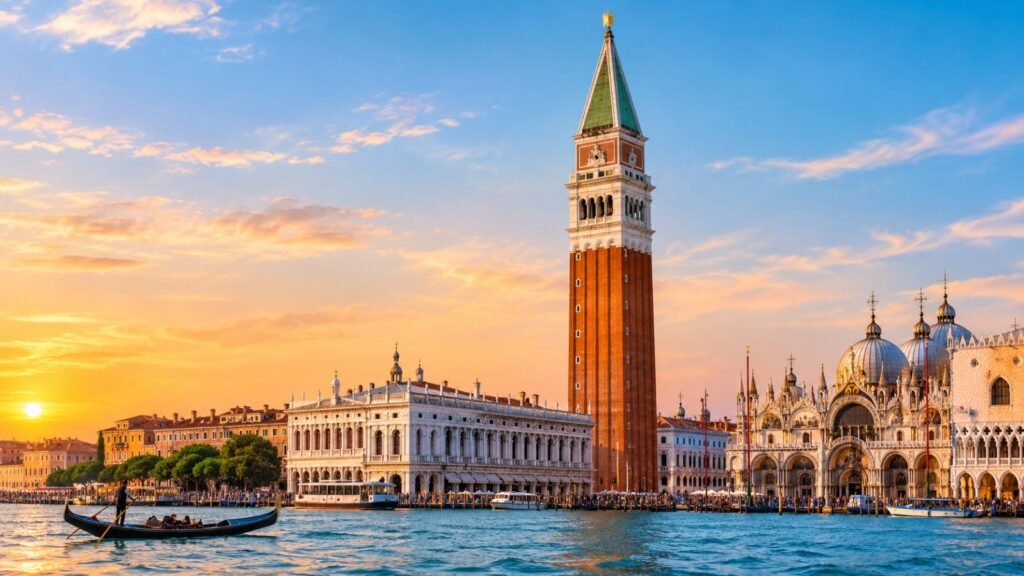
The History of the Campanile di San Marco: 1,100 Years of Venice’s Bell Tower
Few buildings tell the story of a city as completely as the Campanile di San Marco. It began as a watchtower guarding a young lagoon settlement, grew into the voice of the Venetian Republic, survived fire, lightning and earthquakes for nearly a thousand years – and then, on a summer morning in 1902, collapsed into a heap of bricks in front of a stunned crowd. The tower you see today is a faithful rebuild, finished in 1912, that was designed to look as if nothing had ever happened.
This guide walks through every chapter of that story: the medieval origins, the Renaissance rebuild that gave the tower its golden angel, Galileo’s famous telescope demonstration, the bells that ran daily life in the Republic, the dramatic collapse and the decade-long reconstruction. If you’re planning a visit, our complete visitor guide covers the practical side.
Origins: A Watchtower on the Lagoon
The story of the Campanile begins at a time when Venice was still a young and vulnerable settlement scattered across muddy islands. Construction of the first tower on this spot is traditionally dated to the late 9th or early 10th century, under Doge Pietro Tribuno, who ruled from 888 to 912. Venetian tradition often gives 912 as the founding year – a date the city remembered exactly a thousand years later, when the rebuilt tower was inaugurated.
That first structure was almost certainly not the elegant bell tower we know today. Historians generally believe it served primarily as a watchtower and a landmark for shipping. From its top, lookouts could scan the horizon for approaching vessels long before they reached the lagoon entrances, and its silhouette helped sailors navigate the treacherous shallows and channels around the city. Like most Venetian buildings, it stood on thousands of wooden piles driven deep into the clay beneath the square – a technique that kept Venice standing for centuries, and which would, much later, play a role in the tower’s downfall.
Over the following two hundred years the tower was repeatedly enlarged and raised. By the 12th century, under Doge Domenico Morosini (1148–1156), it had reached a considerable height and taken on the form of a true campanile, with a belfry for bells. From then on it was no longer just a military lookout but the city’s great public clock and its loudest voice. The lower shaft built in this period – a plain, square brick column with shallow vertical pilasters – is essentially the same design that rises above St. Mark’s Square today.
Doge Pietro Tribuno
Credited with starting the first tower around the turn of the 10th century, as Venice fortified its centre.
Lookout & Lighthouse
Its height made it the perfect point to watch for ships and guide sailors through the lagoon channels.
12th-Century Belfry
Raised under Doge Domenico Morosini, the tower became a true campanile and the city’s public clock.

Key Dates in the Campanile’s History
Filter by era, search for a keyword, or tap a column header to sort.
🔔 Campanile Timeline
Sortable • Filterable| Year ↕ | Event ↕ | Era |
|---|---|---|
| 888–912 | First tower begun under Doge Pietro Tribuno as a watchtower and landmark. | Medieval |
| c. 1150 | Tower raised and completed as a bell tower under Doge Domenico Morosini. | Medieval |
| 1489 | Lightning sets the wooden spire on fire and destroys it. | Renaissance |
| 1511 | A strong earthquake badly cracks the tower, triggering a major rebuild. | Renaissance |
| 1513 | Rebuild completed by Bartolomeo Bon; the golden angel is hoisted to the top in July. | Renaissance |
| 1538–1546 | Jacopo Sansovino builds the marble Loggetta at the base of the tower. | Renaissance |
| 1609 | Galileo Galilei demonstrates his telescope to Venetian officials from the belfry. | Late Republic |
| 1745 | One of many lightning strikes causes serious damage and costly repairs. | Late Republic |
| 1776 | A lightning rod is finally installed, ending centuries of fire damage. | Late Republic |
| 14 Jul 1902 | After days of cracking, the tower collapses completely. Nobody is killed. | Modern |
| 25 Apr 1903 | Foundation stone of the new tower laid on St. Mark’s Day. | Modern |
| 25 Apr 1912 | Rebuilt Campanile inaugurated – “where it was and how it was”. | Modern |
| 2000s–2010s | Foundations reinforced with titanium ties to counter new cracking. | Modern |
Fire, Earthquake and the Renaissance Rebuild
Being the tallest structure in a flat lagoon city has one obvious drawback: lightning. Throughout its history the Campanile was struck again and again, and in 1489 a bolt set fire to the wooden spire at the top and burned it away completely. Only a little over two decades later, in March 1511, a powerful earthquake shook the region and left deep cracks in the brickwork. The tower was now both damaged and incomplete, and the Republic decided on a thorough restoration.
The project was entrusted to Bartolomeo Bon, a master builder from Bergamo, working to a design associated with the architect Giorgio Spavento. The work gave the Campanile the silhouette that defines it to this day. Above the brick shaft, Bon built an open belfry in white Istrian stone, with four arched openings on each side to let the sound of the bells pour out over the city. Above that came an attic decorated with the lion of St. Mark and allegorical figures of Venice, and finally a tall pyramidal spire clad in copper that would later weather to its distinctive green.
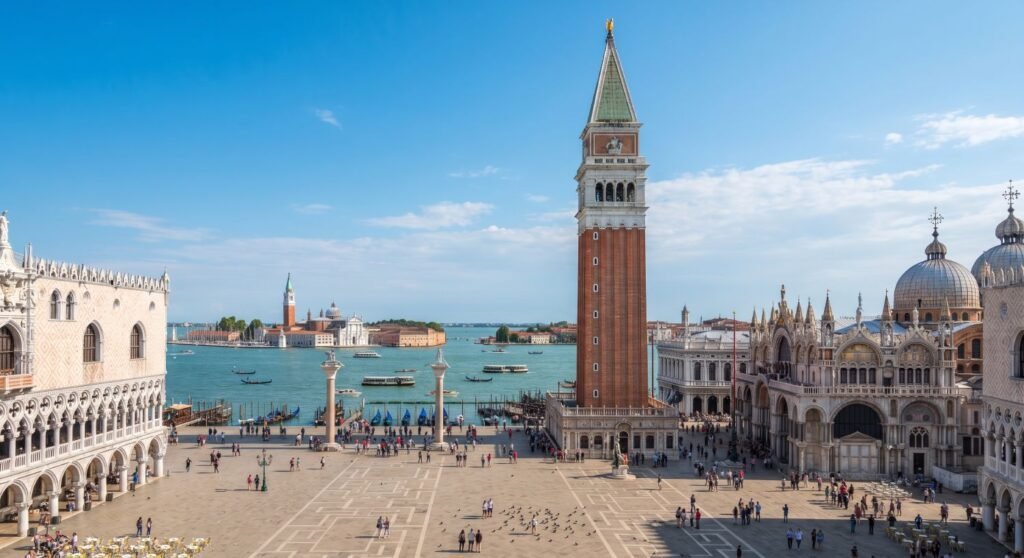
The crowning moment came on 6 July 1513, when a gilded statue of the Archangel Gabriel was hoisted onto the top of the spire. Chroniclers describe music, celebrations and wine poured from the summit in honour of the occasion. The angel was mounted on a pivot, so that it turned with the wind and acted as a giant weathervane – a practical touch on a building that had always served sailors. Today the angel still catches the sunlight above the square, and it remains the finishing touch you'll notice in almost every photo of the view from across the basin.
Istrian Stone Belfry
White stone arches on all four sides let the bells ring out across every corner of the city.
Bartolomeo Bon
The Bergamo-born builder who completed the restoration and gave the tower its classic form.
The Golden Angel
A gilded Archangel Gabriel, raised in July 1513, turns with the wind as a weathervane.
Galileo, Lightning and Life Around the Tower
In August 1609, the Campanile played a small but memorable part in the history of science. Galileo Galilei, then a professor at the University of Padua, carried his newly improved telescope up the tower to show it to members of the Venetian government. From the belfry, the officials could make out ships far out at sea and church towers on distant islands hours before they would have been visible to the naked eye. For a maritime power that depended on knowing what was approaching its shores, the military and commercial value was obvious, and the demonstration helped Galileo secure a better position and salary from the Republic.
Lightning remained the tower's great enemy. Strikes in the 16th, 17th and 18th centuries repeatedly damaged the spire and the masonry, and the 1745 strike was serious enough to require extensive repairs. Only in 1776 was a lightning rod installed, following the ideas recently popularised by Benjamin Franklin – and from then on the fires stopped.
The tower also shaped public life at its foot. In the Middle Ages a wooden cage, known as the cheba, could be hung from the shaft to display clergy found guilty of serious misconduct – a humiliating punishment in full view of the busiest square in Venice. On a happier note, the Campanile became the stage for the famous Volo del Turco during Carnival, in which an acrobat slid down a rope from the belfry to the Doge's Palace. Today's Volo dell'Angelo, which opens the Venice Carnival, is a modern revival of that tradition. You can explore the tower's links to the government building next door on our page about the Doge's Palace and the bell tower.
Galileo's Telescope
In 1609 Galileo showed Venetian officials distant ships through his telescope from the belfry.
Lightning Rod, 1776
After centuries of strikes and fires, a lightning conductor finally protected the spire.
Volo dell'Angelo
The Carnival "flight" from the tower revives a centuries-old acrobatic tradition.
Five Bells That Ran a City
Before pocket watches and public clocks were common, Venetians organised their day by sound, and the Campanile was the city's master clock. Its five bells each had a name and a precise civic job: calling workers to the shipyards, announcing noon, summoning nobles to council, opening Senate sessions and, grimly, marking executions. Anyone in Venice could tell from the pattern of ringing what was happening in their government.
The most important was – and still is – the Marangona, the largest bell, whose name comes from the marangoni, the carpenters of the Arsenal shipyards. It marked the start and end of the working day. Tap through the bells below to see what each one did.
🔔 The Bells of the Campanile
Tap a bellRang at dawn and dusk to mark the working day for the city's craftsmen and shipbuilders, and also called the Great Council to its meetings. It was the only bell to survive the 1902 collapse intact and still rings today.
Announced midday. Its name recalls the old canonical "ninth hour" of prayer, and Venetians used it to pause for lunch.
Its quick ringing told the nobility to hurry to the Doge's Palace for council meetings – in early times many arrived on horseback, hence the name.
Signalled the sessions of the Senate, whose members were known as the Pregadi, "those who are asked" to attend.
The ominous bell: it announced executions carried out between the two columns of the Piazzetta, the waterfront space beside the Doge's Palace.
The Morning the Campanile Fell
By the end of the 19th century, the Campanile was showing its age. Centuries of lightning damage, patched repairs, the weight of the belfry and spire, and the slow movement of the soft ground beneath had weakened the old brick shaft. Alterations to the base, including work connected to the Loggetta and to openings in the walls, may also have disturbed the structure. In early July 1902, a long crack appeared on the north side and began to widen visibly day by day.
Engineers inspected the tower, the square was closed off, and the bells were silenced to avoid vibration. On the morning of 14 July 1902, shortly before 10 a.m., the Campanile simply folded in on itself. In a matter of seconds, almost 1,000 years of history slid down into a pyramid of bricks and dust that filled the corner of the square. Photographs of the moment, and of the eerie gap left in the Venetian skyline, went around the world.
Remarkably, nobody was killed. Because the warning signs had been taken seriously, the area had been cleared, and the only victim was the caretaker's cat. The damage to surrounding buildings was also smaller than many feared: the tower collapsed almost vertically, sparing the Basilica and largely sparing the Doge's Palace. The Loggetta at its base, however, was crushed under the rubble, and four of the five bells were smashed. Only the great Marangona survived intact.
Days of Warning
A widening crack on the north face led authorities to clear the square before the collapse.
No Human Victims
The tower fell almost straight down. The caretaker's cat was the only casualty.
What Was Lost
The Loggetta was crushed and four bells shattered; only the Marangona survived.
"Dov'era e com'era": Rebuilding the Tower
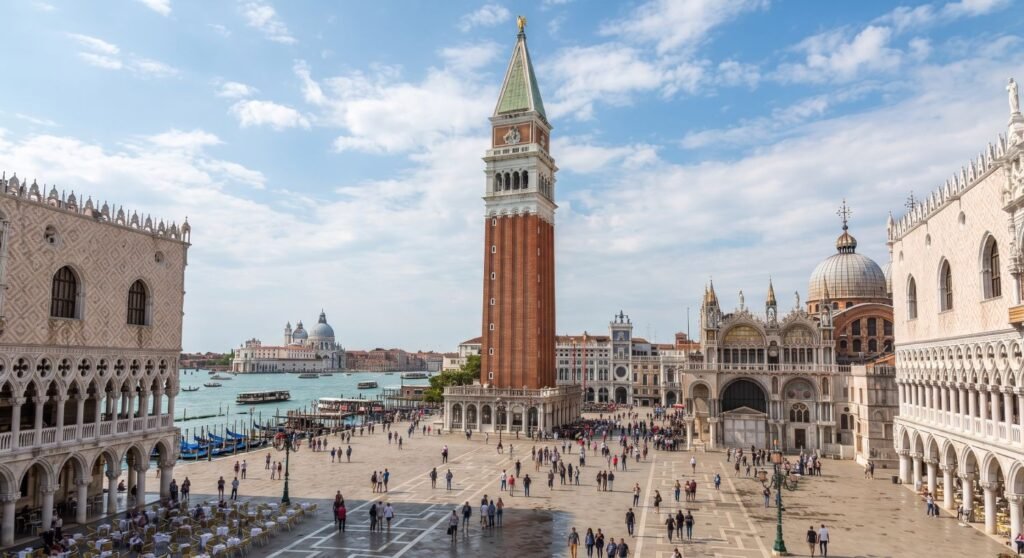
Venice did not hesitate for long. On the very evening of the collapse, the city council voted to rebuild the Campanile "dov'era e com'era" – where it was and how it was. The phrase became a slogan and later a principle of heritage conservation far beyond Venice. Donations arrived from Italy and abroad, and there were serious debates about whether to build something new; in the end, the city chose to recreate the familiar silhouette as faithfully as possible.
The first task was to understand why the old tower had failed. When the rubble was cleared, engineers examined the ancient foundations and found the wooden piles in surprisingly good condition, but decided to enlarge the foundation platform considerably so that the weight would be spread over a much wider area. The foundation stone of the new tower was laid on 25 April 1903, the feast of St. Mark, the city's patron saint.
Above ground, the builders copied the old design closely while quietly improving its engineering. The new shaft was built to be better braced and lighter than its predecessor, and bricks, stone elements and decorative fragments recovered from the rubble were reused wherever possible. The Loggetta was painstakingly pieced back together from its surviving fragments. The four broken bells were recast, a gift from Pope Pius X, who as Giuseppe Sarto had been Patriarch of Venice before his election in 1903. Exactly nine years after the foundation stone was laid, on 25 April 1912, the rebuilt Campanile was inaugurated with great ceremony. Its interior design also anticipated the modern era – today visitors reach the top via the lift rather than the old ramps.
⚖️ Old Tower vs. Rebuilt Tower
Tap headers to sort| Feature ↕ | Before 1902 ↕ | Since 1912 ↕ |
|---|---|---|
| Location | St. Mark's Square | Exactly the same spot |
| Exterior design | 12th-c. shaft + 1513 belfry and spire | Faithful replica of the same design |
| Foundations | Original wooden piles and stone base | Base platform significantly enlarged |
| Structure | Heavy, repeatedly patched brickwork | Lighter, better-braced construction |
| Bells | Five historic bells | Marangona + four recast bells |
| Access to top | Internal ramps and stairs | Elevator for visitors |
| Loggetta | Sansovino's original | Reassembled from salvaged fragments |
The Campanile in the Modern Era
The rebuilt tower has stood for more than a century, but Venice's particular challenges have not gone away. The city sits on soft, compressible ground, and St. Mark's Square is the lowest point in town, flooding regularly during acqua alta, the seasonal high tides. Salt water seeping into the masonry and the gradual settling of the ground produced new cracks in the base of the tower towards the end of the 20th century.
Rather than wait for history to repeat itself, engineers launched a long-term consolidation project in the 2000s. The centrepiece was a ring of titanium ties placed around the foundations, a material chosen because it resists corrosion in salty water and holds the base together without adding much weight. Monitoring instruments track the tower's movements, and the MOSE flood barriers at the lagoon inlets, operational since 2020, now help protect the square from the worst high tides.
Today the Campanile welcomes visitors from all over the world, who ride up in a matter of seconds to enjoy one of the most famous panoramas in Italy. Because the platform is small and demand is high, it's worth reading up on waiting lines and the best time to visit before you go, and checking the current opening hours. In peak season, tickets can even sell out for popular slots.
Titanium Foundations
Corrosion-resistant titanium ties now encircle the base to hold the masonry together.
Acqua Alta
The square is Venice's lowest point; the MOSE barriers now reduce the worst flooding.
A Living Landmark
The tower still rings its bells and draws visitors for the city's highest public viewpoint.
🎟️ See 1,100 years of history from the top. Skip-the-line ticket with audio guide – from €25.
Book Campanile Tickets ➔Seeing the History for Yourself
Knowing the story changes how you experience the tower. Before you head up, take a few minutes at the base to look at the Loggetta: the patched-together marble and bronze are the visible scars of 1902. Inside, the lift whisks you through a shaft that is barely more than a century old, yet at the top you stand among bells that echo a ritual stretching back to the Middle Ages – and the Marangona hanging there is the very bell that survived the collapse.
From the belfry, try to imagine Galileo pointing his telescope towards the Adriatic, or the lookouts of the 10th century watching for ships. Then walk the four sides of the platform and see how the whole city spreads out below, a view that explains better than any map why Venice needed a tower here in the first place. If you're still deciding, our honest take on whether the Campanile is worth it may help, and the practical information page covers the dress code, luggage storage and more. To find your way, see how to get there, whether by vaporetto or on foot, and book through our tickets page.