
The Campanile Dress Code:
What to Wear to Venice’s Bell Tower
Here’s the short answer first: there is no official dress code for the Campanile di San Marco. Nobody at the entrance will check your shoulders, your knees or your shoes. But “no dress code” doesn’t mean “anything works.” The bell tower sits in the middle of St. Mark’s Square, right next to a church that does enforce strict clothing rules, and its belfry is an open-air platform nearly 100 meters above a windy lagoon. What you wear can decide whether you enjoy the view for half an hour or shiver through five minutes of it.
In this guide: why the Campanile has no formal dress code, the smart-casual outfit that works for every season, how to dress if you’re also visiting St. Mark’s Basilica, the best shoes for Venice, what to bring (and leave behind), city rules that can earn you a fine, and a full FAQ at the end.
👗 Campanile Outfit Planner
What to Wear to the Campanile, Season by Season
Pick the month you’re travelling and the table below changes with it. Planning to visit St. Mark’s Basilica on the same day? Switch on the Basilica check and every item that could get you turned away at the Basilica door is swapped for a safe alternative.
| Item | What to wear | Why it matters at the tower |
|---|
Is There an Official Dress Code at the Campanile?
No. Unlike St. Mark’s Basilica a few steps away, the Campanile di San Marco is not a place of worship you walk through. It’s a bell tower with a lift, a small ticket area at the base and an observation level in the belfry. Staff check your ticket and bags, not your outfit, and there is no posted rule about sleeveless tops, shorts or skirt length for going up the tower.
That surprises a lot of visitors, because the whole of St. Mark’s Square feels like sacred ground. The Basilica’s doorkeepers are famous for turning people away over bare shoulders, and many travelers assume the same applies to every building around the piazza. It doesn’t. You could, in theory, ride the Campanile lift in shorts and a tank top without anyone saying a word.
So why write a whole guide about dressing for it? Because the Campanile has a very real unofficial dress code, and it’s set by three things the ticket desk can’t control: the weather at the top, the ground at the bottom, and whatever else you plan to see that day. Get those right and you’ll be comfortable. Get them wrong and the tower will remind you quickly.
No Clothing Checks
Tickets and bags are checked at the entrance, but there’s no rule about covering shoulders or knees for the tower itself.
The Basilica Is Different
St. Mark’s Basilica next door strictly requires covered shoulders and knees, so plan your outfit around it if you’re visiting both.
Weather Sets the Rules
The open belfry is exposed to wind, sun and cold, which makes practical clothing far more important than formal clothing.
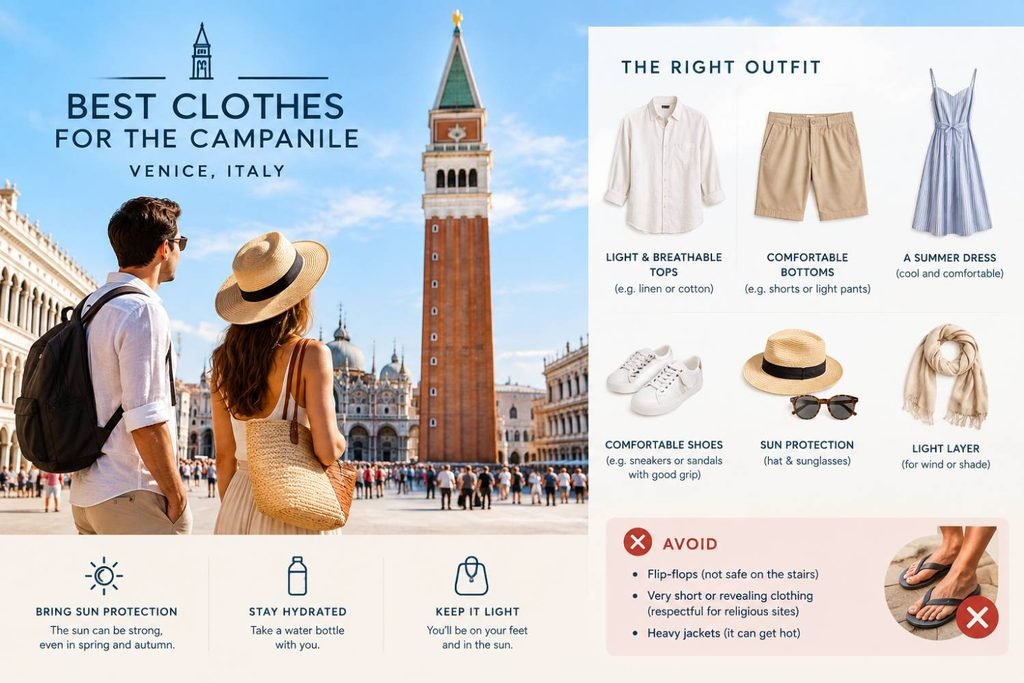
The Best Outfit: Smart-Casual With Layers
If you want one outfit formula that works for the Campanile in almost any month, it’s this: smart-casual clothing that covers your shoulders and reaches your knees, a removable layer on top, and comfortable closed shoes with a good grip. That’s it. It’s what most well-prepared visitors end up wearing, and it’s the closest thing the tower has to a real dress code.
Smart-casual matters for a simple reason: the Campanile is almost never the only thing you’ll do that day. It sits at the centre of the most photographed square in Italy, surrounded by the Basilica, the Doge’s Palace, the historic cafés under the arcades and some of the city’s best restaurants. An outfit that is respectful enough for a church and neat enough for a café terrace lets you move from one to the next without going back to your hotel.
Layers matter because the Campanile has two climates. At the bottom you’re standing on sun-soaked stone surrounded by thousands of people, often in a queue with little shade. At the top you’re in an open belfry roughly 60 meters above the square, catching whatever wind is crossing the lagoon. A breezy spring morning can feel almost wintry up there, and even in summer the airflow is noticeably stronger. A light jacket, cardigan or overshirt that you can tie around your waist or stuff into a small bag solves both problems.
Shoes are the part people underestimate most, and we’ll cover them in detail below. The short version: skip anything you wouldn’t happily walk ten kilometers in, because that’s roughly what an average day in Venice adds up to.
Tops
T-shirts, blouses, polo shirts or light knitwear. Sleeveless is fine for the tower, but bring a cover-up for the Basilica.
Bottoms
Chinos, jeans, linen trousers, or skirts and dresses that reach the knee. Very short or loose, floaty skirts are awkward in the wind.
Outer Layer
A packable windbreaker, denim jacket or cardigan. It takes little space and makes the belfry far more pleasant.
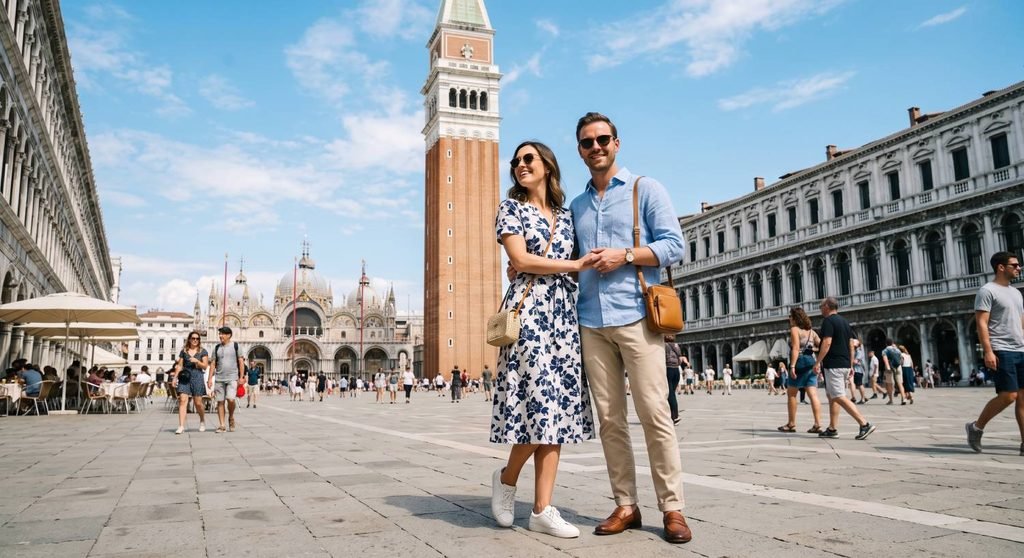
The Basilica Factor: Why Its Rules Shape Your Outfit
The single biggest reason to dress modestly for the Campanile has nothing to do with the tower. It’s the building across the square. St. Mark’s Basilica is an active cathedral, and its entry rules are clear and consistently enforced: shoulders must be covered, knees must be covered, and very low necklines are not accepted. Staff at the door do turn people away, and in peak season that can mean losing your place after a long wait.
Most visitors combine the two sights, and it makes sense. They share the same square, the Campanile gives you a bird’s-eye view of the Basilica’s domes, and several ticket options bundle nearby attractions together. If there’s any chance you’ll step inside the Basilica on the same day, dress for the Basilica from the start. The Campanile won’t mind, and you won’t be scrambling for a cover-up at the church door.
A lightweight scarf or shawl is the easiest solution in summer. You can wear a sleeveless top for the heat of the queue and the tower, then drape the scarf over your shoulders before entering the church. For knees, a midi skirt, linen trousers or longer shorts work far better than trying to improvise. Some visitors are offered disposable paper cover-ups at the entrance, but that’s not something to rely on.
If you still need to sort out entry, my guide to Campanile tickets explains the different options, including combined visits around St. Mark’s Square.
Shoulders Covered
No tank tops, spaghetti straps or strapless tops inside the Basilica. A scarf or light cardigan fixes this in seconds.
Knees Covered
Short shorts and mini skirts won’t pass. Knee-length or longer is the safe choice for both men and women.
No Large Bags
Large backpacks aren’t allowed in the Basilica and must be stored elsewhere first, so a small day bag saves time.
Shoes: The Most Important Part of Your Outfit
Here’s a slightly ironic fact: the Campanile is one of the easiest climbs in Venice because there isn’t one. A lift takes you to the belfry in well under a minute, so you won’t be tackling hundreds of steps as you would in many Italian bell towers. Yet shoes still matter more than anything else you wear, because getting to the tower is a different story.
Venice is a city built for walking. Nearly every route to St. Mark’s Square crosses several bridges with stone steps, and the paving is made of smooth, worn stone that becomes slippery in the rain or when the tide leaves it damp. Add crowds, narrow alleys and the fact that most visitors walk far more than they expected, and you have a recipe for sore feet and blisters if you choose badly.
The best choice is a comfortable pair of sneakers, walking shoes or supportive sandals with a closed heel strap and a rubber sole. Leather loafers with grippy soles work well if you want something smarter for dinner afterwards. Avoid high heels, thin-soled ballet flats and flip-flops. Heels catch in gaps between stones and are hard work on bridge steps; flip-flops offer no grip on wet stone and no protection in a crowd.
From autumn to early spring, think about water too. St. Mark’s Square is among the lowest points in the city, which is why it’s often the first place to get wet during acqua alta, the seasonal high tides. The MOSE flood barriers have reduced the most dramatic floods in recent years, but a moderate tide can still leave puddles or standing water in the square. Waterproof boots or shoes are worth packing for trips between October and January. My guide to the best time to visit explains how the seasons affect your trip in more detail.
Best Choice
Broken-in sneakers or walking shoes with rubber soles, ready for bridges, stone paving and long days on your feet.
Avoid
High heels, flip-flops and brand-new shoes. Venice’s slick stone and endless bridge steps punish all three.
Acqua Alta Season
From autumn to early spring, waterproof boots keep you dry if the square floods. Shops nearby sell cheap overshoes on high-tide days.
What to Wear, Season by Season
Venice’s climate swings more than people expect for an Italian city. Summers are hot and sticky, winters are damp and genuinely cold, and the lagoon adds wind and humidity to both. Because the Campanile’s opening hours change with the seasons, your visit might fall in bright midday heat or in the last cool light of the evening, so it’s worth thinking about the time of day as well as the month.
Spring (March to May) is layering season. Mornings can start cool, afternoons turn pleasantly warm, and the breeze at the top keeps things fresh. A T-shirt with a light sweater or denim jacket over it, comfortable trousers and sneakers is ideal. Bring a thin rain jacket in March and April, when showers roll in off the Adriatic.
Summer (June to August) is all about staying cool without breaking the Basilica’s rules. Linen and cotton are your friends; synthetic fabrics become unbearable in the humid queue. Loose linen trousers, a midi dress or knee-length shorts with a breathable shirt work well. Sunglasses are essential, because the glare off the lagoon and the pale stone of the square is intense. A hat is useful in the queue but should fit snugly, or be taken off before you step onto the windy belfry.
Autumn (September to November) starts almost like summer and ends almost like winter. Early autumn calls for light layers; by November you’ll want a proper jacket, a scarf and waterproof shoes. This is also when acqua alta becomes more likely and when fog can roll across the lagoon, softening the view but chilling the air.
Winter (December to February) is the season people underestimate. Temperatures often hover just above freezing, the damp air feels colder than the thermometer suggests, and the belfry is completely exposed. A warm coat, scarf, gloves that let you use your phone and a close-fitting hat will make the difference between lingering at the top and rushing back to the lift. The reward is a quieter tower and, on clear days, crisp views towards the snowy Dolomites.
Spring & Autumn
Light layers, a windbreaker and closed shoes. Add waterproofs later in autumn when tides and rain pick up.
Summer
Breathable linen or cotton, sunglasses and sunscreen, plus a scarf to cover your shoulders if the Basilica is on your list.
Winter
Warm coat, scarf, touchscreen gloves and waterproof boots. The belfry feels much colder than the square below.
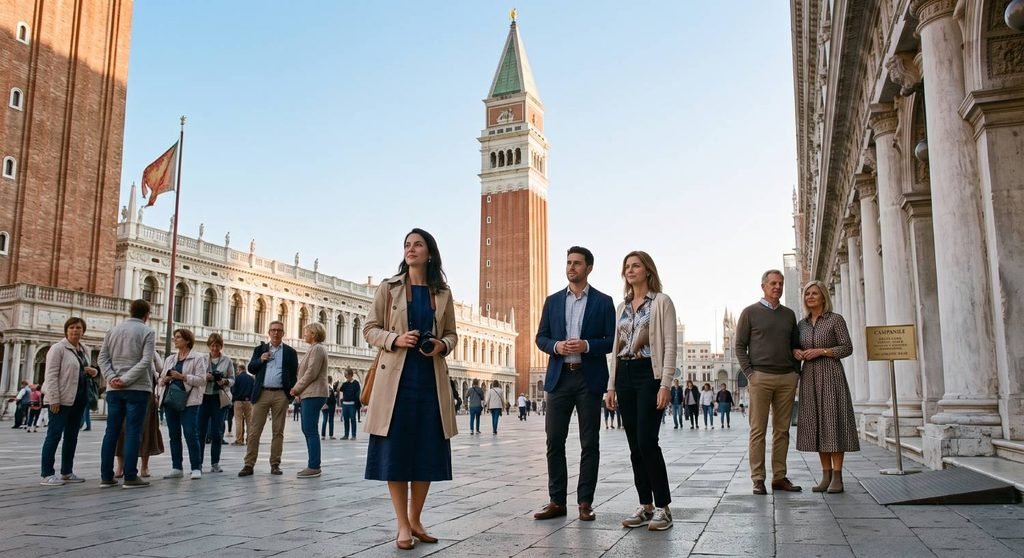
Dressing for Wind, Sun and the Bells
The belfry is open on all four sides, with arches protected by railings and mesh. That means the view is unobstructed by glass, but it also means nothing shields you from the elements. On a breezy day, loose items become a liability. Wide-brimmed sun hats, flowing scarves and very light, floaty skirts all have a way of misbehaving up there. If you wear a hat, choose one that fits closely or be ready to hold it; a hat lost over the edge is a hat gone for good.
Sun is the other factor. There’s shade under the belfry roof, but the light reflecting off the lagoon is strong, especially around midday. Sunglasses help you actually see the view instead of squinting at it, and a little sunscreen goes a long way during the wait at the base.
Then there are the bells themselves. The Campanile is still a working bell tower, and you share the belfry with the bells. If you happen to be up there when they ring, the sound is powerful and very close. It’s a memorable experience rather than a danger, but it’s worth knowing in advance, particularly if you’re visiting with small children or you’re sensitive to loud noise. You can read about each bell’s history and purpose in my article on the bells of the Campanile.
Secure Your Accessories
Snug hats, tucked-in scarves and a sunglasses strap or case keep your things with you on the open platform.
Protect Your Eyes
Sunglasses cut the glare from the lagoon and pale stone, so you can enjoy the panorama in bright conditions.
Ready for the Bells
The bells ring right beside the viewing area. It’s loud but short; families with small kids may want to be prepared.

Outfit Sorted? Book Your Ticket
Skip-the-line ticket for St. Mark’s Campanile including an audio guide. Less time standing in the sun or cold means more time enjoying the view.
Bags and What to Carry
Your bag is part of your outfit at the Campanile, and smaller is better. Visitors go through a security check at the entrance, the lift is compact, and the belfry fills up quickly at popular times. A large backpack slows you down at every stage, gets in other people’s way on the crowded viewing level, and becomes a real problem if you continue to the Basilica, where large bags are not allowed inside.
A small crossbody bag, belt bag or compact day pack is ideal. It keeps your hands free for photos, sits close to your body in the crowds of St. Mark’s Square, and makes the security check quick. As in any busy tourist area, keep zips closed and valuables out of back pockets.
Inside that bag, you only need a few things: your ticket on your phone, a charged phone or camera, sunglasses, a packable layer, a small bottle of water in summer and a scarf if you’re heading to the Basilica afterwards. Leave suitcases at your hotel or a luggage storage point; nobody wants to drag one over Venice’s bridges, and they’re not welcome at the square’s attractions.
Ideal Bag
Crossbody or belt bag that’s easy to open at security and stays secure in the crowds.
What to Pack
Phone ticket, sunglasses, a light layer, water in summer and a scarf for the Basilica.
Leave Behind
Suitcases, large backpacks and anything bulky. Use your hotel or a luggage storage service instead.
Venice City Rules That Affect What You Wear
The Campanile may not have a dress code, but the city of Venice does have public conduct rules, and some of them are about clothing. They apply throughout the historic centre, and St. Mark’s Square is exactly where local police are most likely to enforce them.
The most important one: walking around in swimwear or bare-chested in the historic centre is not allowed. Venice is not a beach town, despite being surrounded by water, and visitors in bikinis or without a shirt can be stopped and fined. If you’re coming from the Lido beaches, change before you head back to San Marco.
Other rules aren’t about clothing but are worth knowing while you’re dressed for a day around the square. Sitting down to picnic on the ground or on monument steps, swimming in the canals and feeding the pigeons are all prohibited. Keep your visit respectful and you won’t have anything to worry about.
No Swimwear
Bikinis, swim trunks and beach cover-ups alone aren’t acceptable in the historic centre and can lead to a fine.
Keep Your Shirt On
Going bare-chested in the streets and squares is prohibited, however hot the day gets.
Respect the Square
No picnicking on the ground or monument steps and no feeding pigeons. Enjoy a café instead.
Dressing for Great Photos at the Top
For many visitors, the Campanile is the photo stop of the trip, so it’s fair to think about how your outfit will look in pictures. The backdrop from the belfry is a sea of terracotta rooftops, green-grey lagoon water, white marble and the lead domes of the Basilica. Solid, rich colours such as deep blue, emerald, burgundy, mustard or crisp white stand out nicely against it, while very busy patterns can compete with the view.
Think about practicality too. Because the arches are covered with protective mesh, the best shots are often taken close to the railing. Clothing that lets you move comfortably, lean slightly and turn to catch the light will serve you better than anything restrictive. If you’re planning a sunset visit for photos, bring a layer that also looks good on camera; you’ll likely be wearing it by the time the light turns golden.
And if you’re heading for dinner in the square afterwards, a smart-casual outfit carries you from golden-hour photos on the tower to a table under the arcades without needing to change.
Colours That Pop
Solid jewel tones or crisp white stand out against terracotta roofs and the lagoon.
Freedom to Move
Comfortable cuts let you get close to the mesh and find angles without fuss.
Sunset to Dinner
A smart-casual look works for golden-hour photos and a meal in St. Mark’s Square afterwards.
Campanile Dress Code Quick-Facts
Final Thoughts
The Campanile won’t judge your outfit, but the weather, the stone streets and the Basilica next door will. Dress smart-casual, cover your shoulders and knees if you’re combining sights, wear shoes made for walking and bring one layer for the wind. Do that, and your only job at the top is to enjoy the best view in Venice.
Dress for the Day
Plan your outfit around everything you’ll see, not just the tower. The Basilica sets the strictest standard.
Comfort Beats Style
Good shoes and a warm layer matter more than looking dressed up, though smart-casual gives you both.
Check Before You Go
Look at the forecast and tide predictions on the morning of your visit and adjust your layers and shoes.
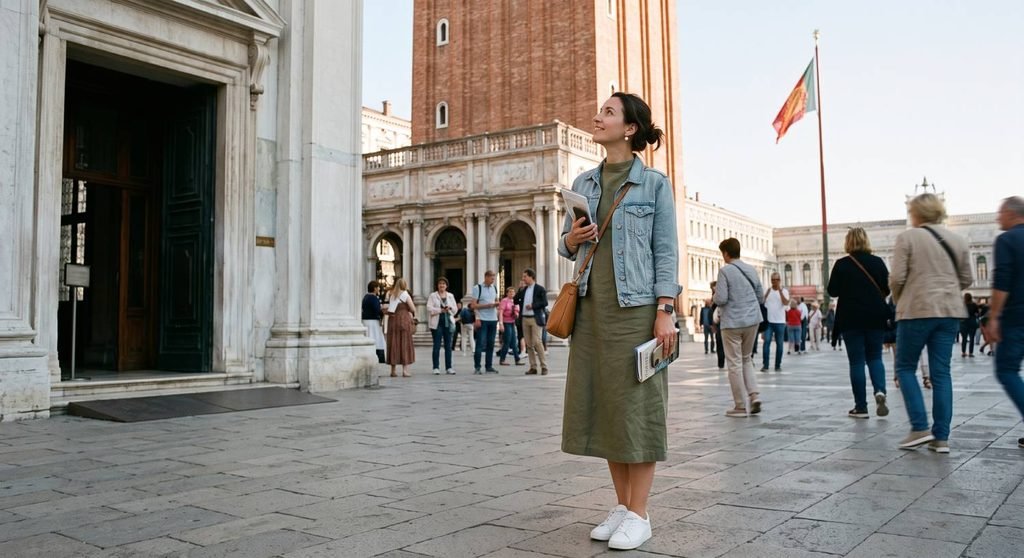
Frequently Asked Questions
Quick answers to the questions visitors ask most about what to wear to the Campanile di San Marco.