
The Marangona: The Story of the Great Bell of St Mark’s Campanile
Stand in St Mark’s Square at midnight, when the day-trippers have gone and the cafés have stacked their chairs, and you may hear it: a deep, slow, bronze voice rolling down from the top of the Campanile and out across the lagoon. That sound belongs to the Marangona, the largest and most famous bell of St Mark’s bell tower. For centuries it told Venetians when to start work, when to stop, when to go to parliament and when to go to bed. It survived the dramatic collapse of the tower in 1902, when everything around it turned to rubble. And it is still ringing today.
Most visitors to Venice ride the elevator to the top of the Campanile for the view, and many of them walk right past the bells without knowing their stories. This article is about the one bell worth knowing above all: where its name comes from, what it meant to the Venetian Republic, how it escaped destruction, and how you can see it (and hear it) for yourself.
Key Facts & Specifications
Tap through the interactive categories below to explore the physical attributes, historical roles, and survival milestones of Venice’s legendary bell.
| Attribute | Specification | Significance |
|---|---|---|
| Weight | 3,625 kg (36 quintals) | Over 3x heavier than the smallest bell (Renghiera). |
| Diameter | 1.80 metres | Massive bronze scale engineered to project sound across open water. |
| Musical Pitch | Note A (A2) | Served as the foundational reference tone for tuning all other belfry bells. |
| Casting Year | 1820 | Over two centuries old; the sole survivor of the 1902 collapse. |
| Function | Target Audience | Historical Purpose |
|---|---|---|
| Workday Call | Arsenale Workers | Signalled the start of the working day for shipwrights and carpenters. |
| Council Summon | Patrician Nobility | Gave the first warning call for sessions of the Great Council (Maggior Consiglio). |
| Midnight Toll | Entire City | Exempted from modern night laws; rings late into the night over San Marco. |
| Feast Plenum | Citizens & Visitors | Leads all five bells in harmonious unison during major holidays like St Mark’s Day. |
| Milestone Year | Event | Outcome |
|---|---|---|
| 1820 | Austrian-Era Recasting | Melted down and forged into the current historic bell by Dalla Venezia. |
| 14 July 1902 | The Great Collapse | The Campanile collapsed vertically; the Marangona survived intact while 4 companion bells shattered. |
| 1908–1910 | Safekeeping & Return | Stored safely inside the Doge’s Palace before being hoisted back up the unfinished tower. |
| 25 April 1912 | Grand Re-Inauguration | Rung out on St Mark’s feast day to celebrate the completed reconstruction (com’era, dov’era). |
Tap & Explore
Use the selector pills above to instantly filter table records between physical specs, government roles, and timeline milestones.
A2 Resonant Tone
Engineered to anchor the entire musical pitch framework of St Mark’s belfry, setting a natural standard for harmony.
The Sole Survivor
The only bell from the historic set to endure the 100-metre plunge in 1902 without cracking or shattering into fragments.
A Bell Named After Carpenters
Discover the fascinating origin behind the name of Venice’s historic bell, deeply rooted in the city’s ancient shipbuilding traditions.
The “Marangona”
In the Venetian language, a marangon is a carpenter—a term still heard in local workshops today, naming the bell that marked the working day.
Shipwrights of the Arsenal
The bell was named after the marangoni of the Arsenal, setting the working hours for the men who built the fleet that made Venice rich.
The Campanon
Also known as the Carpentiera or the Campanon (“the big one”), it is the heaviest and deepest bell in the tower, carrying the furthest voice.
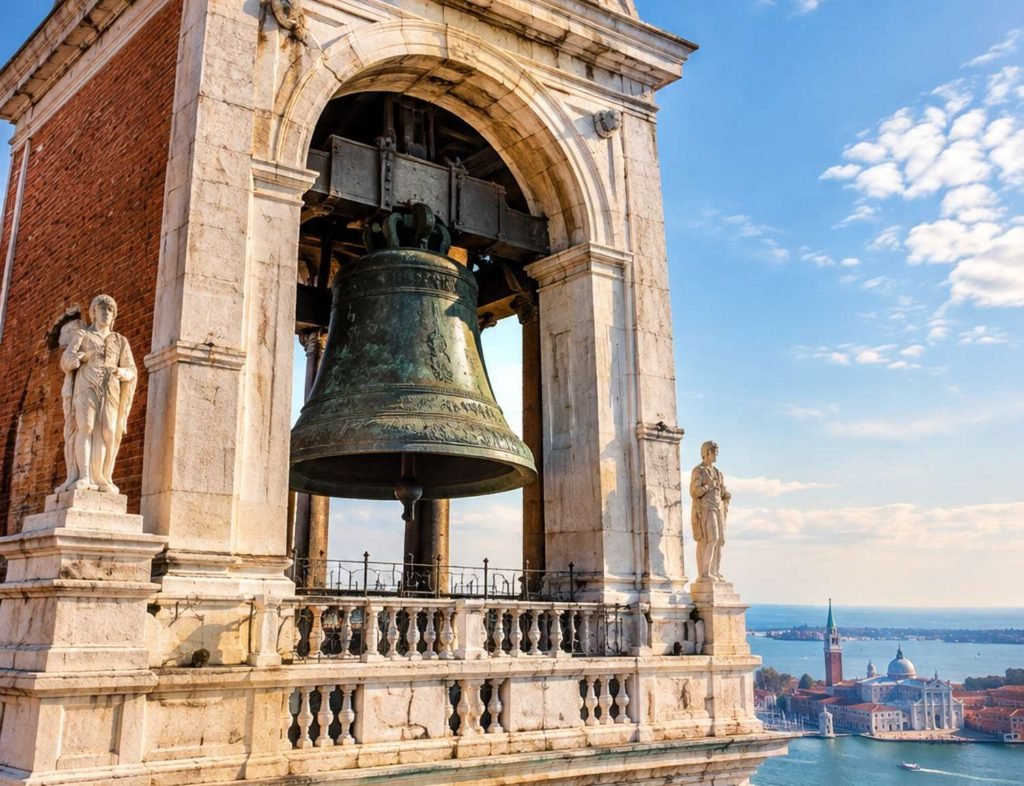
The name “Marangona” sounds exotic to English speakers, but to a Venetian it is as down-to-earth as a name can be. In the Venetian language, a marangon is a carpenter, a word you can still hear in the city’s workshops today. The bell takes its name from “marangon”, or carpenter, and chimed in the morning and evening to mark the beginning and end of the working day.
The legacy of the Venetian fleet: These were not just any carpenters. The marangoni who gave the bell its name were the shipwrights of the Arsenale, the vast state shipyard in the eastern part of the city. The bell was named after the marangoni, or carpenters, of the Arsenal, and its voice set the working hours for the men who built the fleet that made Venice rich.
The bell also has other names. It is also known as the Carpentiera or the Campanon, meaning the big one. That last nickname is simple and accurate: the Marangona is the heaviest and deepest bell in the tower, the one whose voice carries farthest.
The Arsenale and the Rhythm of Work
Explore how the world’s pre-modern industrial powerhouse synchronized its daily labor through the powerful voice of St. Mark’s bell tower.
The Pre-Modern Assembly Line
Thousands of workers, known as arsenalotti, built galleys on an assembly line with hulls moving past specialist teams of craftsmen.
The City’s Clock
In a city without wristwatches or factory sirens, the Marangona rang across rooftops at the start and end of the working day.
A Closing Bell for the Republic
At sunset, fifteen series of sixteen strokes signaled the end of the working day for the entire republic, like a stock exchange closing bell.
To understand why the city’s greatest bell was named after shipbuilders, you have to understand what the Arsenale meant to Venice. At its height, it was one of the largest industrial complexes in the pre-modern world. Thousands of workers, known as arsenalotti, built galleys on something close to an assembly line, with hulls moving past specialist teams of carpenters, caulkers, rope makers and oar makers. Venetian tradition likes to tell the story of a galley assembled in the time it took a visiting king to finish his banquet. Whether or not that tale is exaggerated, the Arsenale was the engine of Venetian sea power, and its workforce needed a clock.
Measuring time and civic order: In a city without wristwatches or factory sirens, the bell tower of St Mark’s was that clock. The Marangona rang out across the rooftops at the start of the day, and the carpenters picked up their tools. It rang again as the light faded, and they set them down. The start of the laborers’ workday varied with the hours of daylight, which means the bell followed the seasons: early in summer, later in winter, always tied to the sun rather than to a fixed hour.
The bell’s authority reached well beyond the Arsenale. Its evening ringing was the signal for the whole working city to wind down. At sunset it rang fifteen series of sixteen strokes, marking the end of the working day for the Arsenal, the heavy trades and the government offices. Think of it as the Venetian version of a closing bell on a stock exchange, except that it closed an entire republic.
There is a quieter, more uncomfortable story attached to the morning ringing as well. Venice was home to the world’s first ghetto, where the city’s Jewish population was confined at night behind locked gates. According to one account, the Jews confined in the Ghetto could only go out after the Marangona had sounded. The same bell that sent carpenters to work also measured the limits of freedom for part of the population, a reminder that the sound of civic order meant different things to different Venetians.
The Voice of the Republic
Discover how the Marangona served not just as a work bell, but as a crucial political instrument for one of history’s longest-lived republics.
The Great Council
The Marangona gave the first call for sessions of the Maggior Consiglio, the assembly and main governing body of the patrician nobility.
The Trottiera Call
Followed by a second bell prompting patricians to set their horses at a trot to reach the assembly before doors were firmly closed.
Opening Act of Democracy
The deep warning note that told the ruling class to drop everything and head for the Doge’s Palace for governance.
The Marangona was not only a work bell. It was also a political instrument, part of the machinery of one of the longest-lived republics in history.
Summoning the patrician nobility: Venice was governed by a complex system of councils, and the most important of them was the Great Council (Maggior Consiglio), the assembly of the patrician nobility. When it was time for a session, the bell tower did the summoning. The Marangona also gave the first call for the sessions of the Great Council, the main governing body of Venice.
That first call was followed by a second, from a smaller bell with a wonderfully descriptive name. The Trottiera gave the second signal to the patricians who had to attend the Great Council; hearing it, they set their horses at a trot, in the days before riding horses was forbidden in the city. Once the Trottiera fell silent, latecomers were out of luck. When the bell stopped ringing, the doors were firmly closed and anyone who arrived late was shut out.
So the Marangona was the opening act of Venetian democracy, such as it was: the deep warning note that told the ruling class to put down whatever they were doing and head for the Doge’s Palace.

The Five Bells of St Mark’s
Discover how the five bells formed an audible calendar and government noticeboard for the whole city, each with its own unique role.
The Marangona & Nona
The Marangona marked the workday and council calls, while the Nona handled midday and the final mail deadline from Rialto.
Trottiera & Pregadi
The Trottiera hurried nobles to council, and the Pregadi (Mezza Terza) summoned the Senate and called the faithful to services.
The Renghiera & Plenum
The grim Renghiera announced capital executions, while the Plenum united all five bells in harmonious balance for major feasts.
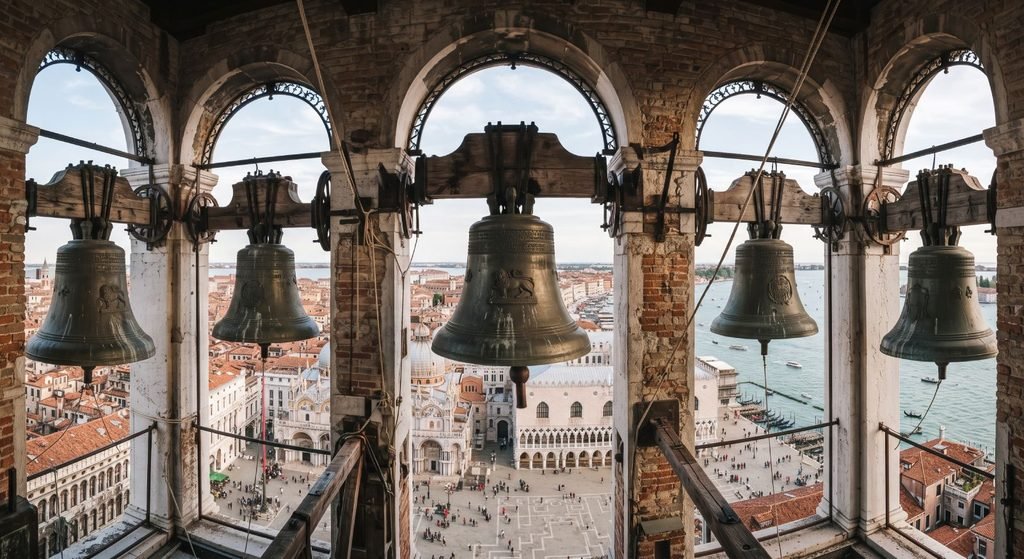
The Marangona has four companions in the belfry, and each one had its own job. Together they formed a kind of audible calendar and government noticeboard for the whole city. From largest to smallest:
The major bells: The Marangona, the great bell, marked the working day and the first call to the Great Council. The Nona, named after the ninth canonical hour of prayer, handled midday. It marked, and still marks, midday, and it also signalled the final deadline for sending mail from Rialto. The Trottiera, as we have seen, hurried the nobles to their council. The Pregadi, also called the Mezza Terza, summoned the Senate. Its ringing announced the meetings of the Senate, whose members were called Pregadi, and it also called the faithful to religious services. The name comes from the fact that senators were formally “prayed” or invited by the Doge to attend.
The grim bell of justice: The smallest bell had the grimmest job. The Renghiera, from “renga”, the speech made in defence of the accused before sentencing, is also called the bell of the Maleficio or of the Executed, and its ringing announced capital executions. Executions in Venice traditionally took place between the two great columns in the Piazzetta, within sight of the tower, so the bell’s toll was a signal that everyone in the city understood.
The Plenum and musical tuning: On the great feast days, all five sound together. The “Plenum”, in which all five bells ring out at the same time, is reserved for the most important feasts of the liturgical year and for special anniversaries. One of those occasions is 25 April, the feast of St Mark, the city’s patron saint. The bells were also tuned to sound well together. The musical commission that oversaw the recasting studied the note of the surviving bell, which gave a natural A, and set the new bells to E, D, C sharp and B so that the five would sound in harmonious balance. In other words, the Marangona was the reference point. Every other bell in the tower was tuned to it.
A Bell With a Borrowed Name
Discover the untold story of the bell in the Campanile today—why it carries the Marangona name through a historic misunderstanding.
Lightning & Re-Casting
Over the centuries, lightning strikes, cracked bells, and the fall of the Republic led to multiple recasts and a new series of bells.
The 1820 Austrian Era Set
Under Austrian rule, Dalla Venezia melted older bells together to create a new set of five, the largest of which hangs in the tower today.
Role vs. Bronze
Is it a fake? Not really. In historic towers, names belong to the role rather than the particular lump of bronze.
Here is the part of the story most guidebooks skip. The bell you see in the Campanile today is called the Marangona, and it does the Marangona’s job. But it is not the medieval Marangona that summoned the carpenters of the Renaissance Arsenale.
A history of damage and renewal: The bells of St Mark’s have been broken, recast and replaced many times. The tower was struck by lightning again and again over the centuries, and bells cracked, fell or went out of tune. On Tuesday 11 August 1489, after lightning hit the tower, the bells fell onto the floor of the bell chamber; they were not seriously damaged and were put back in place. Back then the belfry held more bells than today. Accounts from that period speak of six or seven bells, more than the five of the present day.
For a while there was even a trophy bell from the eastern Mediterranean. The “Campanon de Candia” arrived in Venice in 1670 from Crete, a possession taken from the Turks, and was only installed in the tower in 1678 for the Feast of the Ascension. It seems to have had no practical purpose and was presumably rung rarely; when it fell to the floor of the bell chamber in 1722, nobody proposed repairing it.
The fall of the Republic and Napoleon’s changes: The real break with the past came after the fall of the Republic. Napoleon’s troops ended Venetian independence in 1797, and in the reorganisation that followed, St Mark’s Basilica, which had been the Doge’s private chapel, became the city’s cathedral. That promotion called for grander bells. After St Mark’s was designated the cathedral of Venice in 1807, the Marangona and the Renghiera, together with the Campanon da Candia and bells from former churches, were melted down by Domenico Canciani Dalla Venezia to make two larger bells between 1808 and 1809. The ambitious new bells were a failure. They turned out to be too heavy and were never used.
So the founders started again. In 1820, Dalla Venezia melted those bells together with the Meza-terza, Trottiera and Nona to create a new series of five. This was during Austrian rule over Venice, and the largest of this 1820 set is the bell that hangs in the tower today.
When the Campanile fell in 1902 and this bell alone survived, it became famous under the historic name. As one Venetian source points out, the surviving great bell came to be called the Marangona in a misunderstanding that lasts to this day: it was not the ancient Marangona, which had ceased to exist in 1809, but the largest of the newer bells cast under the second Austrian rule.
Does that make it a fake? Not really. Bells in historic towers are almost always recast at some point, and the name has always belonged to the role, not the particular lump of bronze. The 1820 bell rang the Marangona’s hours, answered to its name and, as we will see, earned its legend the hard way.

14 July 1902: The Day the Tower Fell
Explore the dramatic collapse of the historic Campanile, known as el paròn de casa, and how the Marangona survived the ruins.
El Paròn de Casa
For roughly a thousand years, the master of the house stood over St Mark’s Square before showing critical age in July 1902.
The Collapse at 9:45 AM
The structure sank vertically into itself on Monday 14 July, miraculously avoiding human casualties according to legend.
The Sole Survivor
While four bells shattered, the great Marangona survived the plunge intact, earning its legendary reputation the hard way.
For roughly a thousand years, in one form or another, the Campanile had stood over St Mark’s Square. Venetians called it el paròn de casa, the master of the house. In July 1902, the master of the house began to show its age.
Early warnings and precautions: Cracks had appeared in the brickwork, and the authorities grew nervous. On 12 July 1902, engineers began monitoring the tower and fenced it off from the public; even a concert planned in the Piazza for the evening of 13 July was cancelled as an extra precaution. Those precautions probably saved lives.
The dramatic collapse: The next morning, the tower came down. At around 9.45 am on Monday 14 July, the entire structure collapsed into a heap of rubble. Witnesses described the tower sinking almost vertically in on itself, which is one reason the neighbouring buildings escaped largely intact. Remarkably, nobody died. According to popular legend, the only casualty was the caretaker’s cat.
Some damage was unavoidable. The front of the Basilica suffered only minor damage, but the Loggetta at the foot of the tower was completely buried under the rubble. The nearby Marciana Library was also partly damaged by the fall.
The survival of the Marangona: And the bells? Four of the five were smashed as the belfry plunged nearly a hundred metres into the square. The fifth was not. Of the five famous bells, only the great Marangona survived intact. The heaviest, deepest bell in the tower had ridden the collapse down and emerged from the rubble whole. It is hard to think of a better way for a bell to earn its reputation.
The survivor and the remains of its companions were taken somewhere safe. Together with the pieces of the four shattered bells, the Marangona was moved inside the Doge’s Palace for safekeeping during the reconstruction of the tower. For nearly a decade, the great bell sat silent in the palace of the government it had once summoned to work.
“Where It Was, As It Was”
Discover the inspiring rebuilding of the Campanile and how the broken bells were recreated and returned to the belfry.
Com’era, Dov’era
The City Council met on the evening of the collapse, deciding to rebuild “how it was and where it was”, creating a global slogan.
Pope Pius X’s Gift
Former Patriarch of Venice and newly elected Pope Pius X funded the reconstruction of the four shattered bells in 1908.
Return of the Marangona
In 1910, tons of bronze bells were raised to the unfinished tower, with the Marangona returning to the height it fell from.
Venice did not debate for long whether to rebuild. On the evening of the collapse, the City Council met urgently and decided the tower should be rebuilt “how it was and where it was”. The phrase com’era, dov’era has since become a slogan for faithful reconstruction far beyond Venice.
A modern structure with a classic exterior: The new tower was a copy on the outside and a modern structure on the inside. Construction began in 1903, and the exterior was a faithful copy, but it was built to more rigorous construction standards for greater safety and stability.
Patronage from Pope Pius X: The broken bells found a patron with a personal connection to the city. Giuseppe Sarto had been Patriarch of Venice when the tower fell, and the following year he was elected Pope Pius X. On 14 July 1908, the sixth anniversary of the collapse, Pius X, who had been Patriarch of Venice for seven years before his election, wrote to Mayor Filippo Grimani saying he wished to pay for the reconstruction of the four bells.
Recasting with precision: The recasting was done with care for the originals. The pieces of the broken bells were reassembled so that plaster casts could be taken, allowing the new bells to be reproduced at the same size and with the same decorations. The casting took place at Sant’Elena, in the old furnace of a disused railway works, where eight tonnes of bronze were melted. Some sources credit the work to the Barigozzi brothers of Milan, who recast the four bells in 1909. Throughout, the Marangona was the reference: the new bells were tuned to harmonise with the one bell that had survived.
Raising the bells and inauguration: Then came the job of getting several tonnes of bronze to the top of a tower that was not even finished yet. Using a lift built by the Stigler engineering works of Milan, the bells were raised up the north side of the tower, facing the Clock Tower, on 22 June 1910, even though the bell chamber was not yet complete; the largest reached the belfry floor at 5 pm. That largest bell was, of course, the Marangona, returning to the height from which it had fallen eight years earlier.
The bells then waited. Two more years passed until 25 April 1912, when the new tower was inaugurated and their sound once again filled Venetian life. The date was chosen deliberately: 25 April is the feast of St Mark himself.
The Marangona by the Numbers
Explore the physical dimensions, musical pitch, and historic age of the great bell at a glance.
Weight & Diameter
The Marangona sounds note A, has a diameter of 1.80 metres, and weighs 3,625 kilograms (36 quintals of bronze tuned to A2).
The Tallest Structure
Over three times heavier than the smallest bell (the Renghiera), it hangs in a tower that stands at 98.6 metres tall in Venice.
Over Two Centuries Old
Dating from 1820, it is by far the oldest bell in the tower, having witnessed the Austrian Empire and the collapse of 1902.
For readers who like hard facts, here is the great bell at a glance. The Marangona sounds the note A, has a diameter of 1.80 metres and weighs 3,625 kilograms. Musicians specify the pitch more precisely: the bell is 36 quintals of bronze tuned to A2, a low, resonant note that carries a long way across open water.
Comparison with companions: For comparison, the smallest bell in the set, the Renghiera, has a diameter of 1.16 metres and weighs 1,011 kilograms, so the Marangona is well over three times heavier than its smallest companion. The whole ensemble hangs in the belfry of a tower that, at 98.6 metres, is the tallest structure in Venice.
A witness to history: The bell itself dates from 1820, which makes it more than two centuries old and by far the oldest bell in the tower. Its four companions are younger than the Eiffel Tower. When you look at the bells in the belfry, the Marangona is the only one that has seen the Austrian Empire, the unification of Italy, and the collapse of the tower that held it.
Hearing the Marangona Today
Discover how the bells still ring today under special municipal exceptions, offering visitors a chance to hear the historic midnight toll and feast day Plenum.
Special Midnight Exception
While Italian cities regulate night bells, St Mark’s bell tower is exempt, and the Marangona is allowed to keep ringing at midnight.
The Midnight Toll
Marked historically by sixteen series of eighteen strokes, standing near San Marco around midnight is one of the best ways to hear the bell solo.
St Mark’s Day Plenum
On great feast days like 25 April, hear the Marangona lead the full Plenum—all five bells ringing together as one of Europe’s great sounds.
The Republic of Venice ended in 1797, the Arsenale no longer builds galleys, and the Great Council has not met for more than two centuries. Yet the bells still ring, and St Mark’s enjoys special treatment in doing so.
Municipal regulations and the midnight exception: Like many Italian cities, Venice has regulations on when church bells may ring, especially at night. The Campanile is an exception. Municipal rules state that the ringing of the bells of St Mark’s bell tower, given its unique character, continues to be governed by special regulations. Unlike its “sisters”, the Marangona is allowed to keep ringing at midnight.
Listening to the midnight toll: That midnight toll is the best chance for most visitors to hear the great bell on its own. Historically it was a long and elaborate ringing. Midnight was marked by sixteen series of eighteen strokes from the Marangona. The patterns used today are not necessarily identical to those of the Republic, and the exact ringing schedule can change for liturgical reasons, but if you are out in the Piazza or on the waterfront near San Marco around midnight, it is worth pausing to listen.
Midday and the feast days: Midday is dominated by the Nona, whose job has always been to mark noon, though some sources note that the Marangona also sounds at midday. And on the great feast days, above all 25 April, you can hear the Marangona leading the full Plenum, all five bells ringing together over the square. If you happen to be in Venice on St Mark’s Day, make sure you are near the Piazza when it happens. It is one of the great sounds of Europe.
Seeing the Marangona Up Close
Discover practical tips for visiting the Campanile’s open loggia, appreciating the bells, and taking in the breathtaking views over Venice.
Go Up With the Story
Take a minute to find the largest bell and remember that this is the one that fell nearly a hundred metres in 1902 and survived.
Be Prepared for Sound
Experiencing the bells at close range in the belfry is loud, physical, and unforgettable—keep an eye on the time around midday.
Timing & Loggetta
Book in advance for calmer conditions, and combine your visit with a look at the rebuilt Loggetta at ground level.
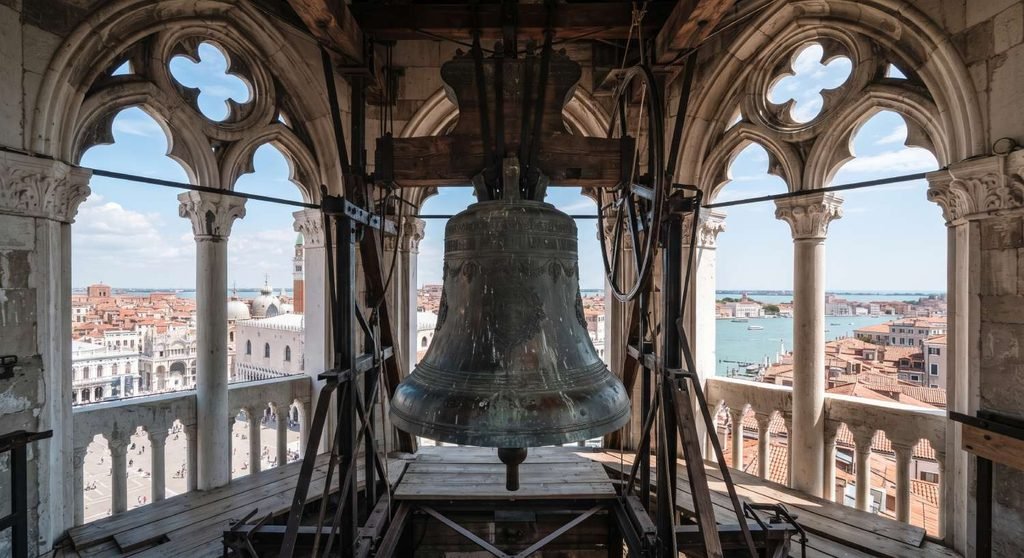
One of the best things about the Campanile is that its viewing platform is the belfry itself. When you ride the elevator to the top, you step out into the open loggia where the bells hang, with the whole of Venice and the lagoon spread out beneath you. The Marangona is right there, close enough to appreciate its size and the patina of two centuries on its bronze.
A few practical tips help make the visit more rewarding:
First, go up with the story in mind. Most visitors look straight past the bells to the view, which is understandable, because the view is extraordinary: the domes of the Basilica, the Doge’s Palace, the Grand Canal, San Giorgio Maggiore across the water and, on clear days, the Dolomites on the horizon. But take a minute to find the largest bell and remember that this is the one that fell nearly a hundred metres in 1902 and survived.
Second, be prepared for the sound. If you happen to be in the belfry when the bells ring, you will experience them at extremely close range. It is loud, physical and unforgettable, and some people love it while others find it startling. If you are visiting with young children or are sensitive to noise, it is worth keeping an eye on the time, especially around midday.
Third, pick your time of day. The Campanile is one of the most popular sights in Venice, and queues in St Mark’s Square can be long, particularly in summer and around the middle of the day. Booking your ticket in advance saves time, and early morning or late afternoon slots tend to offer calmer conditions and softer light for photos. Late in the day, the low sun turns the brick of the tower and the domes of the Basilica a warm gold.
Fourth, combine the visit with the story at ground level. Before or after you go up, take a look at the Loggetta at the foot of the tower. It was the building crushed under the rubble in 1902 and painstakingly rebuilt from its fragments. Between the Loggetta below and the Marangona above, you can trace the whole drama of the collapse and the reconstruction in one visit.
Why a Bell Still Matters
Discover why the Marangona is much more than a museum piece—it remains the living voice and musical keystone of Venice.
More Than a Museum Piece
The Marangona has never really stopped doing its job, telling Venetians what time it is in both a literal and symbolic sense.
A Living History
It carries the memory of the Arsenale, the Great Council, French rule, Austrian domination, and the survival of the 1902 collapse.
Restoring a Voice
When Venetians rebuilt com’era, dov’era, they weren’t just restoring a landmark; they were restoring the city’s voice.
It would be easy to see the Marangona as a museum piece: a big bronze relic hanging in a tourist attraction. But that misses what makes it special. The Marangona has never really stopped doing its job. For centuries, under one bronze body or another, it has told Venetians what time it is in their city, in the most literal and the most symbolic sense.
Carrying centuries of history: It tells the story of the Arsenale, the industrial heart of a maritime empire, in its very name. It carries the memory of the Great Council and the long, strange, remarkably durable Venetian Republic. Its current body records the city’s later history too: French rule, the new cathedral, Austrian domination, and the fumbled ambitions of 1809. It survived the most dramatic day in the modern history of St Mark’s Square. And it became the musical keystone of the reconstruction, the note every other bell was tuned to.
When the Venetians decided in 1902 to rebuild their tower com’era, dov’era, they were not only restoring a landmark on the skyline. They were restoring a voice. The Marangona is that voice. Next time you are in Venice, go up the tower to see it, or stand in the empty Piazza at midnight to hear it. Either way, you will be meeting the oldest resident of the Campanile and the one bell that refused to fall silent.
The Marangona Bell: Your Questions Answered
Everything you might wonder about the oldest voice of St Mark’s Campanile, from its name and history to hearing it for yourself.
What is the Marangona?
The Marangona is the largest and deepest of the five bells hanging in the belfry of the Campanile di San Marco, the bell tower in St Mark’s Square. For centuries its toll structured daily life in Venice, signalling the start and end of the working day.
Why is it called the Marangona?
In the Venetian language, a marangon is a carpenter. The bell was named after the marangoni of the Arsenale, the state shipyard where Venice built its fleet. Its morning and evening toll told these shipwrights when to start and stop work.
Does the bell have any other names?
Yes. It is also known as the Carpentiera, another nod to the carpenters, and as the Campanon, meaning “the big one”. That nickname is simply accurate: it is the heaviest bell in the tower and the one whose voice carries farthest across the lagoon.
What are the other bells in the Campanile?
The Marangona shares the belfry with four smaller bells, each of which once had its own civic job. The Trottiera summoned nobles to meetings of the Great Council, the Nona rang at midday, the Mezza Terza announced sessions of the Senate, and the Renghiera, also called the Maleficio, announced executions.
Did the Marangona survive the collapse of the Campanile?
Yes, and that makes it special. When the bell tower collapsed on 14 July 1902, the Marangona was the only one of the five bells to come through intact. The other four were recast, and the rebuilt Campanile, faithful to the original, was inaugurated on 25 April 1912, the feast of St Mark.
Does the Marangona still ring today?
Yes. The bells of St Mark’s still ring at set times of day and on special occasions. Listen for the lowest, deepest note: that is the Marangona, still sounding over the city as it has for centuries.
Can I see the bell up close?
You can. A lift takes visitors up the Campanile to the belfry level, where the bells hang just above the viewing gallery alongside one of the best panoramas of Venice. Book a timed ticket in advance in high season, and be ready for the volume if you happen to be up there when the bells ring.