
The Bells of St Mark’s Campanile: The Sound That Has Ruled Venice for a Thousand Years
Stand anywhere in Piazza San Marco at the top of the hour and you’ll feel it before you consciously hear it — a low, resonant shudder in the air that rolls off the brick tower at the edge of the square and washes over the pigeons, the gondoliers, the tourists frozen mid-photo. That sound is the voice of the Campanile di San Marco, and for the better part of a millennium it has been the metronome of Venetian life: telling fishermen when to head out, senators when to convene, prisoners when their time had come, and merchants when the markets opened and closed.
The tower itself is famous — 98.6 meters of brick rebuilt after its dramatic 1902 collapse — but it’s the bells inside it that gave Venice its actual pulse. This is the story of those bells: who they are, what they said, how they nearly vanished forever, and why they still matter today.
A Tower Built to Be Heard, Not Just Seen
Most visitors think of the Campanile as a viewpoint – and it is a spectacular one, offering arguably the best panorama in Venice, stretching from the domes of the Basilica to the lagoon islands and, on a clear day, all the way to the Dolomites. But the tower wasn’t built primarily to be looked at. It was built to broadcast sound across a city with no radio, no loudspeakers, and no way to coordinate the daily rhythms of tens of thousands of people except through noise that could travel over rooftops and canals.
Construction of the original tower began in the 9th century as a lighthouse and watchtower, helping ships navigate into the Venetian lagoon. Over the following centuries it was heightened, reinforced, and converted increasingly into a bell tower proper, reaching something close to its final Renaissance form by the early 16th century under the direction of architect Bartolomeo Bon. By then, Venice was not just a city but the beating commercial heart of the Mediterranean, and a city with that much traffic, trade, and political machinery running through it needed a way to communicate across distances instantly. Bells were that technology. The Campanile became, in effect, Venice’s central nervous system, and each bell inside it was assigned an extremely specific job.
Meet the Five Bells – Venice’s Original Announcement System
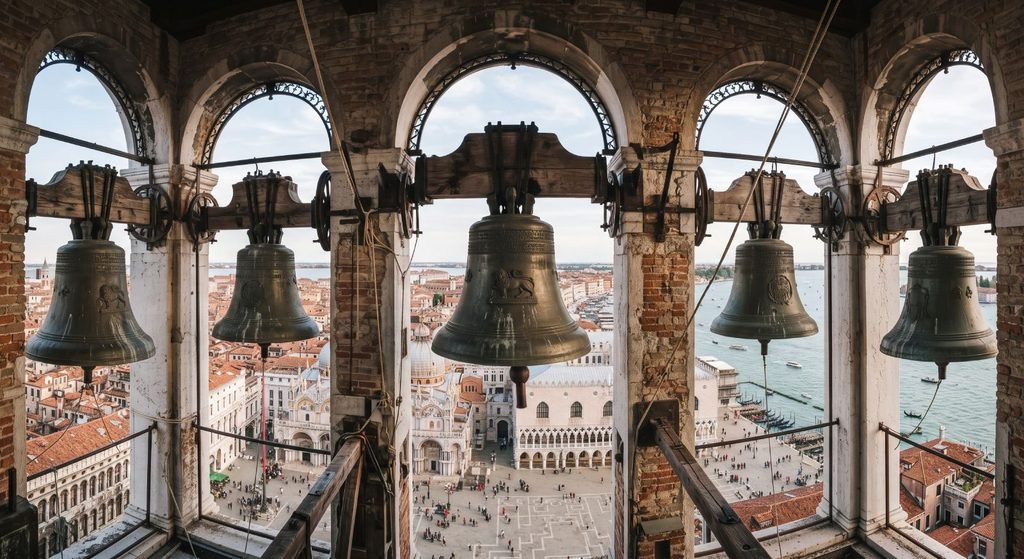
Unlike a church tower with a single bell or a simple set for ringing changes, the Campanile housed five bells, each with a distinct name, a distinct pitch, and a distinct, non-negotiable civic function. This wasn’t decorative campanology – this was infrastructure.
Marangona was the largest and most important of the five, and its name comes from marangoni, the Venetian word for carpenters and shipyard workers. This bell rang to mark the beginning and end of the working day for the artisans and laborers of Venice, most crucially those working in the Arsenale, the enormous state shipyard that was the industrial engine of the Republic. Marangona also tolled during moments of civic gravity: fires, floods, the death of a doge, and other emergencies that required the entire population to know something serious had happened, immediately. Its deep, sonorous tone is the one still heard today, since Marangona was the bell restored and rehung after the tower’s collapse and remains the tower’s principal voice.
Trottiera took its name from trotto, meaning trot, because its ringing signaled members of the Maggior Consiglio – the Republic’s Great Council, the central legislative body of Venetian government – that it was time to hurry, to trot, toward Palazzo Ducale for a session. Imagine the sound as a civic alarm clock for the ruling class: when Trottiera rang, senators and councillors dropped what they were doing and moved with purpose across the city, because Venetian political culture placed enormous weight on punctuality and participation in these assemblies.
Nona rang at midday, marking the canonical hour of “nones” from the Catholic liturgical schedule (roughly the ninth hour after dawn, hence the name), which in practical terms told the whole city it was lunchtime. Workers downed tools, shops paused, and the rhythm of the day shifted. It’s a small detail, but it captures something important about the Campanile’s bells: they weren’t just religious instruments repurposed for secular use, they were genuinely woven into both the spiritual and practical scheduling of an entire city simultaneously.
Mezza Terza rang to announce a specific and rather grim civic event: the opening of a session of the Senate that dealt with judicial matters, in particular sessions related to capital punishment. It also is sometimes associated with signaling the mid-point between Terza (an earlier liturgical hour) and Nona, essentially a midmorning marker to keep the working day’s structure intact.
Renghiera, sometimes called the Maleficio, was the darkest of the five bells in both function and folklore. Its ring announced executions taking place between the two columns in the Piazzetta San Marco, the small square between the Campanile and the waterfront, where condemned criminals were put to death in full public view. When Renghiera tolled, Venetians knew someone was dying nearby, and the sound was deliberately unmistakable and dreaded – a bell rung specifically to make a punishment as public and as symbolically weighty as possible.
Taken together, these five bells formed a language. A Venetian living in the 1400s or 1500s didn’t need a clock or a calendar pinned to a wall; they needed ears. The city spoke to itself in bronze.
The Bells as Political Theater
It’s worth pausing on how remarkable this system really was, because it reveals something essential about how the Venetian Republic actually functioned. Venice was famously a city of merchants and bureaucrats, obsessed with order, timing, and control – the Arsenale itself is often cited as one of history’s earliest examples of large-scale industrial production, with standardized parts allowing a warship to be assembled in a matter of hours. A city that precise about shipbuilding logistics was not going to leave something as important as timekeeping to chance, and the Campanile’s bells were essentially the operating system for that precision.
Trottiera in particular reveals how the Republic wove sound directly into its constitutional machinery. The Maggior Consiglio was, at its height, an assembly of well over a thousand noble members, and getting that many people to a specific place at a specific time in a city built on water, with no cars, no bridges connecting every district, and traffic moving by foot and by boat, was a genuine logistical challenge. The solution was audio: a bell loud enough and distinct enough that no nobleman in Venice could credibly claim he hadn’t heard the summons.
Renghiera, meanwhile, tells you something different – about how Venetian justice used sound as spectacle. Executions were not hidden; they were staged as public demonstrations of state authority, conducted in the most visible and symbolically central location the city had, right beside the seat of government and the basilica. The bell that announced them was part of that theater, ensuring that the moment of punishment reached ears that couldn’t necessarily see the columns themselves.
Galileo’s Telescope and the Tower’s Long Life
The Campanile wasn’t only about bells, even if bells were its primary civic purpose. In August 1609, Galileo Galilei climbed the tower to demonstrate his new telescope to the Doge and members of the Venetian Senate, an event still commemorated as one of the key moments in the popularization of that instrument, since the elevated platform gave observers an ideal vantage point over the lagoon and the ships approaching from the sea. It’s a nice reminder that this tower, first and foremost an acoustic instrument, doubled throughout its history as the best observation deck in the city – a role it still plays for the millions of visitors who ride its elevator up every year.
Through the fall of the Republic in 1797, the Napoleonic occupation, Austrian rule, and Italian unification, the tower and its bells kept functioning, adapting their meanings as the political context around them changed but never losing their basic function: giving the city a shared sense of time.
July 14, 1902: The Day the Tower Fell
Then, on the morning of July 14, 1902, the Campanile collapsed.
Cracks had been appearing in the structure for some time, and on that Monday morning, with almost eerie civic courtesy, the tower gave enough warning that it crumbled straight down into a pile of rubble in the Piazza without killing a single person, though it did crush the small loggetta at its base and damage the corner of the Marciana Library. Remarkably, the only casualty was the caretaker’s cat.
The bells, however, were destroyed in the fall – all except one. Marangona, the great bell that had governed the working hours of the Arsenale for centuries, survived the collapse largely intact, cracked but recoverable, a small bronze miracle sitting in the wreckage of nine hundred years of Venetian history.
The city’s response to the collapse says a great deal about how central the Campanile was to Venetian identity. The very same evening, the City Council of Venice voted to rebuild the tower dov’era e com’era – “where it was and how it was” – a phrase that became something of a rallying cry and is still quoted today whenever Venice restores a damaged monument. Reconstruction took a decade, using the original design as closely as possible while quietly reinforcing the internal structure with modern engineering the medieval builders never had access to, precisely so this kind of collapse could never happen again. The rebuilt tower was formally reopened on April 25, 1912 – chosen deliberately because it was the feast day of Saint Mark, patron saint of Venice, exactly one thousand years, according to tradition, after the very first tower on the site had been consecrated.
Marangona’s Second Life
When the new Campanile reopened in 1912, Marangona – repaired and rehung – became its principal bell once more, and today it’s the bell you actually hear ringing across Piazza San Marco. The other four bells were recast using new bronze, based on historical records of their original tone and size, so that the tower’s voice today is, as closely as modern casting can manage, the same voice Venetians heard for centuries before the collapse.
It’s a small but moving detail: when you stand in the square today and hear the Campanile strike the hour, you are hearing, at least in part, literal bronze that survived from the pre-collapse tower, still doing the job it was cast to do generations ago. Marangona no longer needs to summon carpenters to the Arsenale, since the shipyard’s working rhythms are governed by very different systems now, but its sound persists as the closest thing Venice has to a civic heartbeat, still marking the hours the way it has, one way or another, since the medieval period.
What the Bells Sound Like Today
If you’re planning to visit and want to actually experience the bells rather than just read about them, timing matters. The most dramatic moment is midday, when the tower’s full complement of bells rings out together, a fuller and richer sound than the simple hourly toll of Marangona alone. Standing in Piazza San Marco at noon, surrounded by the Basilica’s domes, the arcades of the Procuratie, and the general roar of one of the most visited public squares on Earth, and hearing that sound roll out from the brick tower above you, is one of those rare travel moments where centuries of history become suddenly, physically present. It’s not a museum artifact behind glass – it’s a machine that has never really stopped running.
Visitors who go up the Campanile itself (the elevator ride to the top is fast and gives access to an open-air viewing gallery just below the bell chamber) get an added bonus: proximity to the bells themselves, close enough to see their scale and appreciate just how much bronze it takes to make a sound that can be heard across the entire historic center of Venice. It’s worth noting that if your visit happens to coincide with the hour, the sound at that close range is genuinely loud – a fact regular visitors quickly learn to plan around, either by timing their ascent to avoid being directly beside the bells at the stroke of the hour, or by embracing it as part of the experience.
Beyond San Marco: Bells Across the City
While the Campanile di San Marco is by far the most famous bell tower in Venice, it’s worth remembering that the city is dense with campanili, nearly a hundred of them tilting at various improbable angles across the lagoon’s soft, unstable ground (the Campanile of Santo Stefano leans in a particularly striking way, visible from the street below). Each parish church historically had its own bell and its own local rhythm, ringing for Mass, for feast days, for funerals, layered on top of the citywide announcements coming from San Marco. In a sense, historic Venice existed inside an intricate soundscape of overlapping bells, each with a different pitch and a different meaning depending on which part of the city you stood in – a layered acoustic map that most visitors today experience only as pleasant ambient sound, without realizing it was once precise, functional information.
Why the Bells Still Matter
It would be easy to treat the Campanile’s bells as a historical curiosity – interesting trivia to mention on a walking tour before moving on to the next attraction. But there’s something genuinely valuable in understanding what they represented. In an era before clocks were common in private homes, before radio, before any form of instant mass communication, Venice built an analog broadcasting system out of bronze and architecture, one precise enough to run the daily schedule of tens of thousands of people, coordinate the sessions of a complex government, and mark the darkest moments of state justice, all through a handful of distinct tones ringing out from a single tower.
That the tower collapsed and was rebuilt exactly as it was, and that its most historically significant bell survived to keep doing its job, adds a layer of resilience to the story that feels distinctly Venetian – a city that has spent over a thousand years negotiating with water, subsidence, invasion, and now mass tourism and rising sea levels, yet keeps finding ways to preserve its own continuity. The bells of the Campanile are a small, audible piece of that continuity: proof that some things in Venice, despite everything the centuries have thrown at the city, have never actually stopped ringing.
So next time you’re standing in Piazza San Marco and the hour strikes, take a moment before reaching for your camera. That sound rolling across the square isn’t just ambience for a photo – it’s Marangona, doing the same job it’s done for Venice, one way or another, for the better part of a thousand years.