
The View from St Mark’s Campanile:
The Best Panorama in Venice
There is exactly one place in Venice where the entire city finally makes sense. From the streets, Venice is a maze — a beautiful, disorienting tangle of narrow calli, blind alleys, and canals that seem to loop back on themselves no matter which way you turn. But climb roughly 98.6 meters (323 feet) into the sky, onto the observation deck of St. Mark’s Campanile, and the maze resolves into a map. Red-tiled rooftops fan out in every direction. The Grand Canal traces its unmistakable S-curve through the city.
This article is a deep dive into that view: what you’ll actually see from the top, why the Campanile beats Venice’s other viewpoints, the history behind the tower you’re standing on, and the practical details — hours, tickets, timing, and tips — that will help you get the most out of your visit.
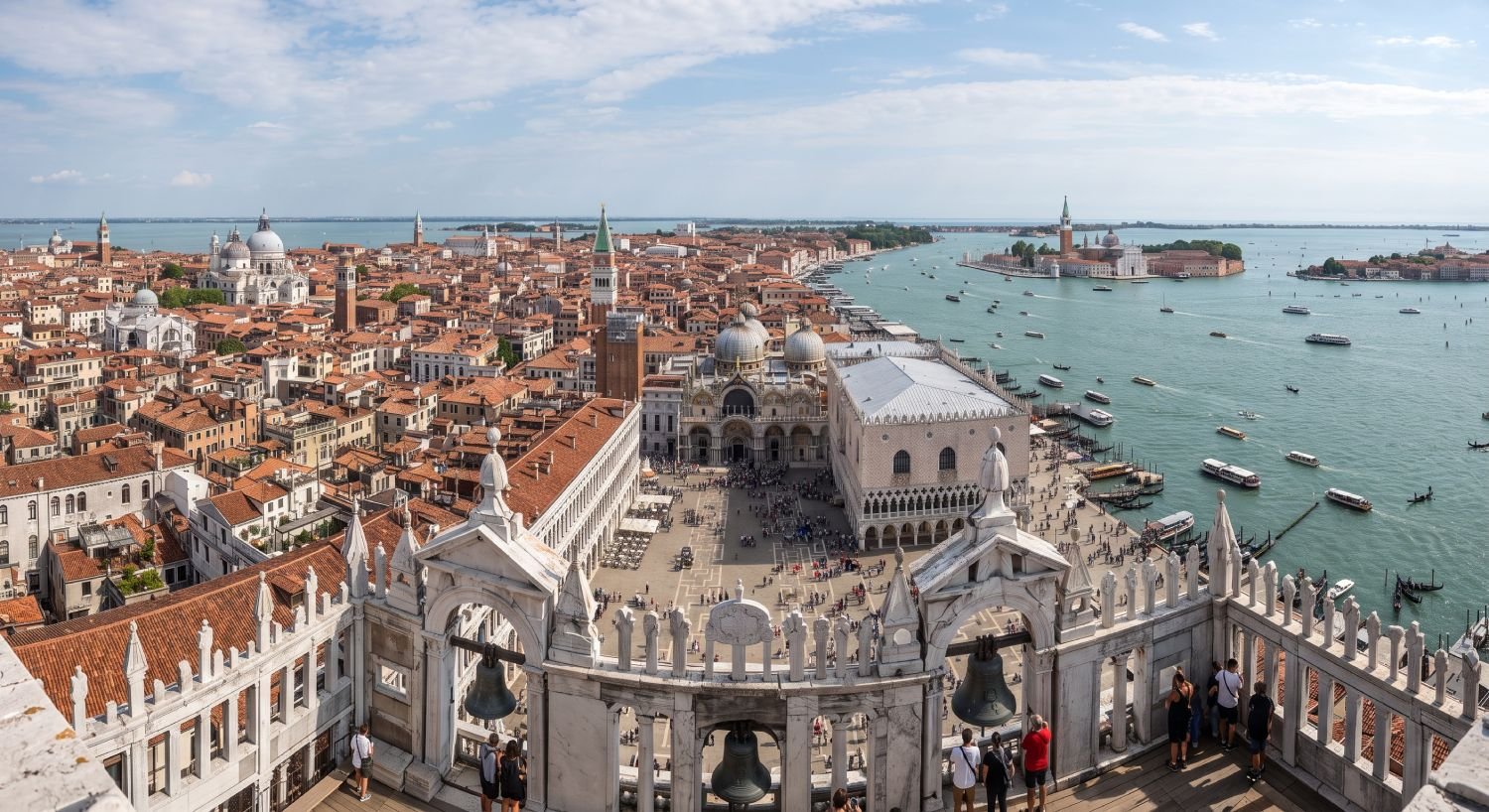
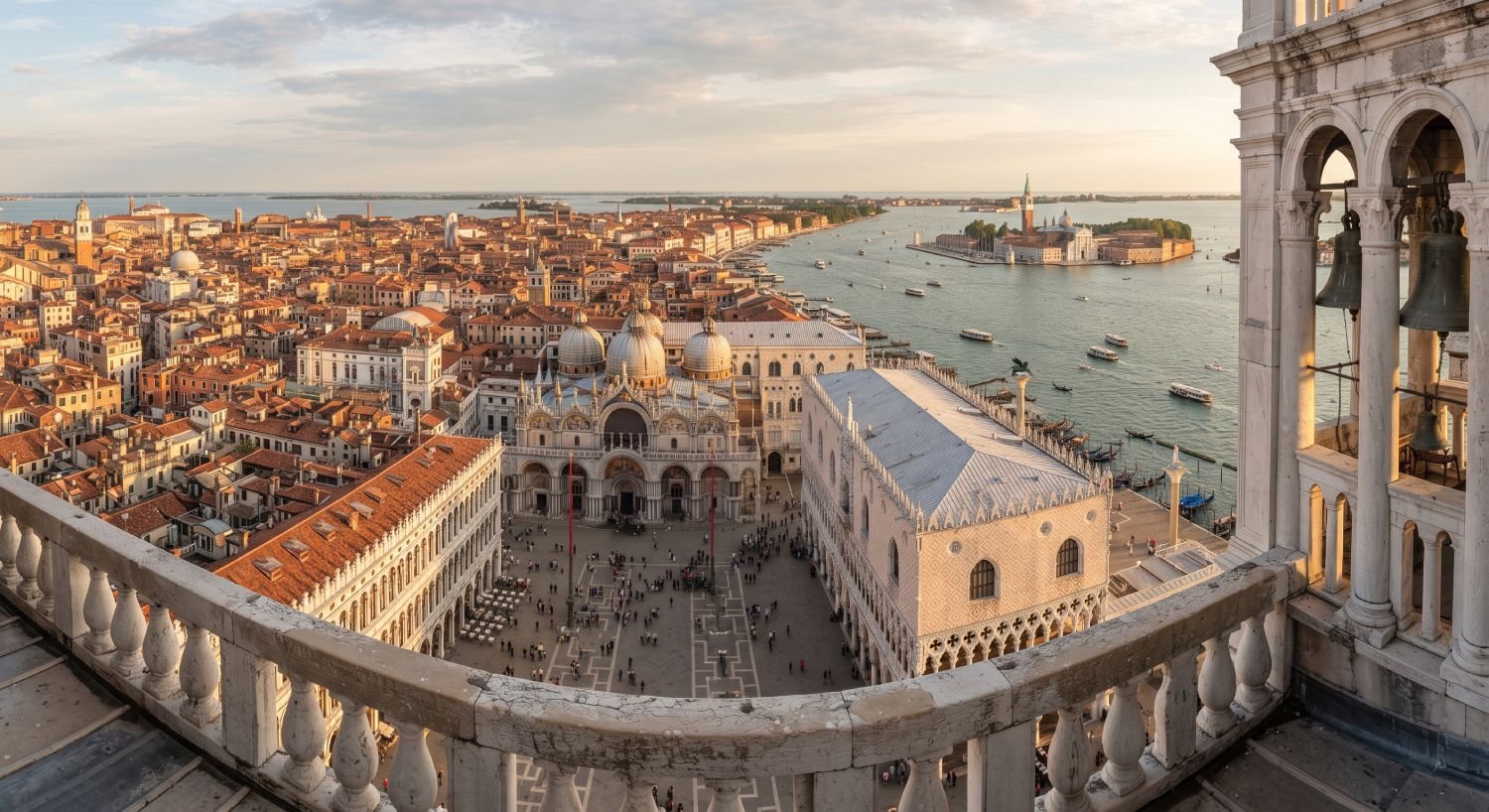
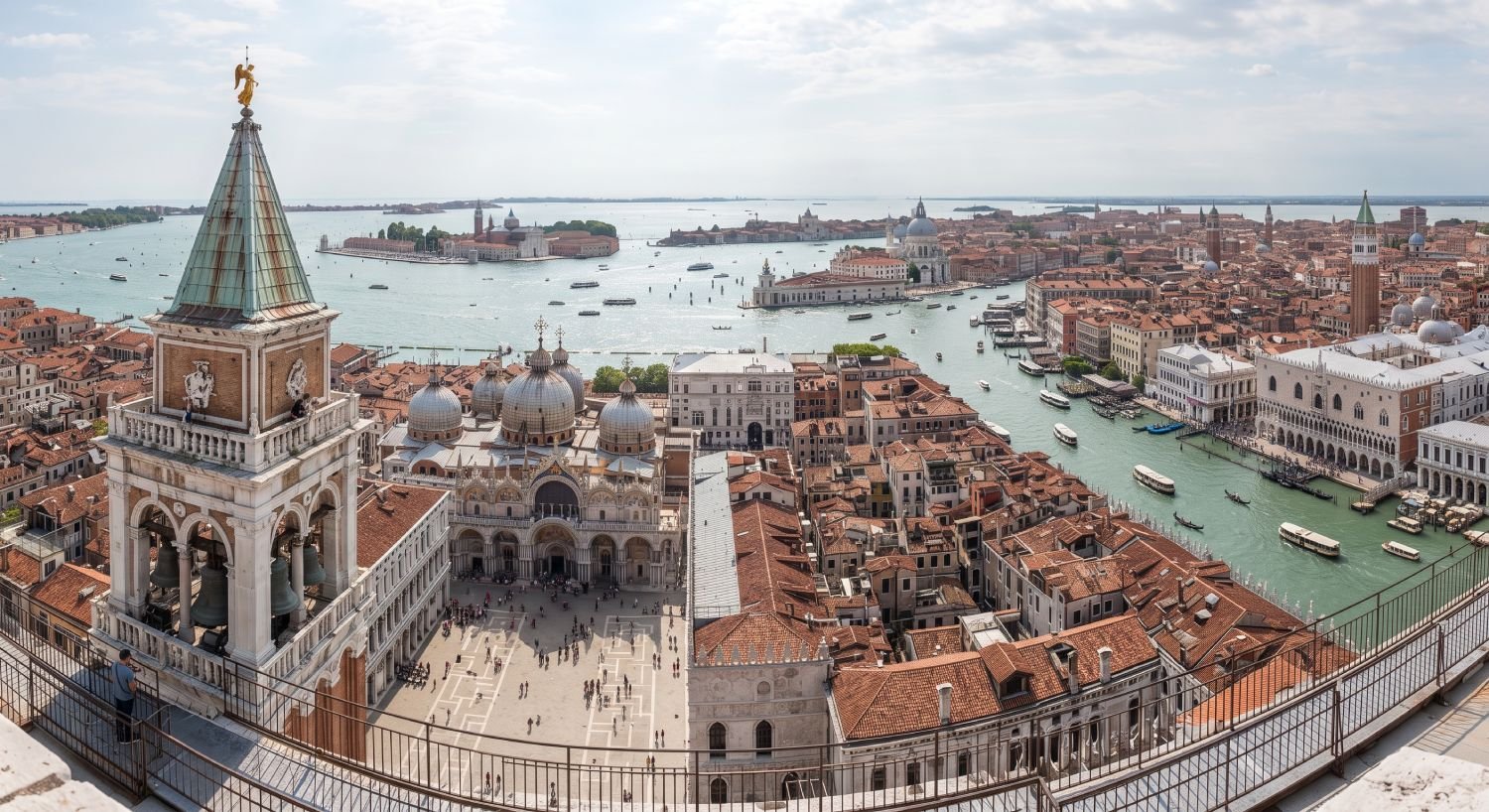
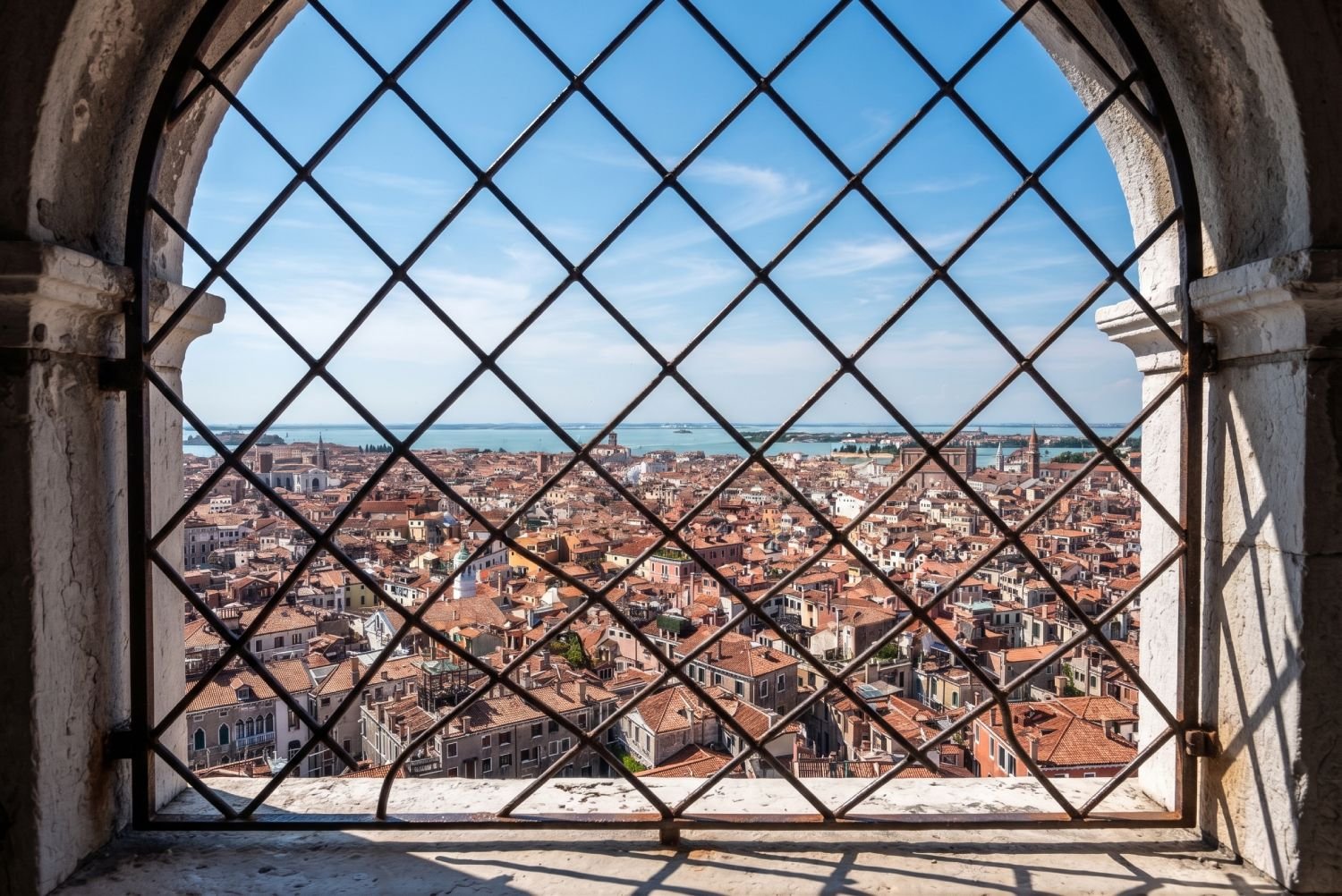
Campanile View Gallery
A Bell Tower Nine Centuries in the Making
9th Century Origins
Originally built as a dual-purpose watchtower, lighthouse, and bell tower for San Marco. Rebuilt over centuries into its iconic form: a brick shaft, loggia, belfry, pyramidal spire, and golden archangel Gabriel weathervane.
Galileo’s Telescope (1609)
In August 1609, Galileo Galilei climbed the tower to demonstrate his newly improved telescope to the Doge and Senate, proving ships could be spotted far before naked-eye visibility.
The 1902 Collapse
On July 14, 1902, after months of cracking, the tower collapsed into a heap of rubble in the Piazza. Miraculously, the only casualty was the caretaker’s cat thanks to timely evacuation warnings.
Rebuilt “Dov’era e Com’era”
Reconstructed stone by stone to match the original design, reopening in 1912. What looks ancient is structurally just over a century old.
The Five Historic Bells & Their Roles
Today, the bells still ring the hours with a thunderous soundtrack across the Piazza. Historically, each bell commanded a specific civic duty:
What You Actually See From the Top
🏛️ Looking South, Over St. Mark’s Basilica
From directly above, the domes of the Basilica di San Marco look almost otherworldly — their lead-covered, onion-shaped roofs catching the light in a way that’s completely invisible from ground level, where the façade dominates and the domes recede.
Beyond the Basilica, the Bacino di San Marco opens up, usually busy with vaporetti, gondolas, and water taxis crisscrossing between the Doge’s Palace, San Giorgio Maggiore, and the Giudecca. On a clear day you can pick out the white dome of Santa Maria della Salute at the mouth of the Grand Canal.
🏔️ Looking North, Over Rooftops Toward the Mainland
This side gives you the most purely “Venice” image: an endless quilt of terracotta rooftops, chimney pots, and occasional rooftop terraces (altana), with church bell towers poking up at irregular intervals across the skyline.
On exceptionally clear days — usually in winter and early spring, after a cold front has scrubbed the haze out of the air — the view extends far past the lagoon to the snow-dusted peaks of the Dolomites on the horizon. It’s a genuinely startling sight: one moment you’re looking at Renaissance rooftops, the next at the Alps.
🌊 Looking East, Toward the Lido & Open Lagoon
This side faces the barrier islands that separate the Venetian lagoon from the Adriatic Sea. You can trace the shape of the lagoon itself — the shallow, marshy expanse of water, mudflats, and fish farms that has protected and isolated Venice for over a thousand years.
From here, you can also pick out the Lido, the long sandbar island famous for its beaches and film festival.
🛶 Looking West, Along the Grand Canal
From this side you can trace the Grand Canal’s path as it snakes through the city, a view that’s genuinely difficult to appreciate from any other vantage point in Venice, since the canal curves constantly and no bridge or rooftop at street level offers a comparable sightline.
You’ll also see the dense cluster of red rooftops that make up the sestieri of San Marco, San Polo, and Dorsoduro.
The View Below: Below all four sides, of course, is Piazza San Marco itself — Napoleon’s famous “drawing room of Europe” — reduced from street level to a tidy rectangle of paving stones, with tourists and pigeons moving across it like pieces on a board. Seeing the piazza’s actual proportions from above helps explain why the square feels so theatrical when you’re standing inside it.
Why the Campanile Beats Venice’s Other Viewpoints
🏬 T Fondaco dei Tedeschi
The rooftop terrace of the T Fondaco dei Tedeschi, a former trading house turned department store near the Rialto Bridge, offers a free (reservation-required) view.
However, it’s considerably lower than the Campanile and doesn’t include St. Mark’s Square in the frame at all — you’re looking mostly toward the Rialto and the Grand Canal.
🏝️ Bell Tower of San Giorgio Maggiore
Located on the island just across the water from St. Mark’s Square, this is arguably the Campanile’s most serious rival. Because it’s on a separate island facing St. Mark’s Square, it lets you photograph the postcard skyline of the Basilica, the Doge’s Palace, and the Campanile itself in a single frame.
Many photographers actually prefer San Giorgio’s tower for this reason. But if you only have time or budget for one tower, the Campanile wins on sheer centrality: you’re standing directly above the beating heart of the city, not looking at it from across the water.
🌉 The Rialto Bridge Viewpoint
The Rialto Bridge offers a lovely but much lower and more limited view, mostly of the Grand Canal traffic passing directly beneath it, with no real panoramic sweep.
⭐ What Sets the Campanile Apart
What sets the Campanile apart from all of these is a combination of height, position, and access. At just under 99 meters, it’s the tallest structure in Venice by a wide margin. It sits at the absolute geographic and symbolic center of the city on St. Mark’s Square.
And unlike most historic Italian bell towers that require climbing hundreds of narrow spiral stairs, the Campanile has a modern lift (elevator) running all the way to the top—installed after the 1912 reconstruction. The original stone staircase has been closed to the public since 1980, so today’s ascent is quick, easy, and takes barely a minute.
Best Time of Day (and Year) to Go
🌅 Early Morning Window
Early morning is the single best window for most visitors. Arriving close to opening time means shorter queues, softer light for photography, and a St. Mark’s Square below that hasn’t yet filled with the day’s crowds.
The low-angled morning sun also tends to pick out the terracotta rooftops beautifully.
🌇 Late Afternoon & Sunset
Late afternoon, toward sunset, is the other prime slot, especially in the hour before closing. The light turns warm and golden, the lagoon starts to shimmer, and if you’re lucky enough to be up there as the sun drops toward the horizon over the western rooftops, it’s genuinely one of the most beautiful moments Venice has to offer.
Because the Campanile often stays open into the evening during spring and summer, a sunset visit is realistic without having to rearrange your whole day around it — just check the specific closing time for the season you’re visiting, since hours shift throughout the year.
☀️ Midday Conditions
Midday is the least rewarding time, both for crowds and for photography — the sun sits directly overhead, flattening the light and casting the piazza below into a harsh, high-contrast glare.
📅 Time of Year & Weather Safety
As for time of year: winter and early spring offer the clearest air and the best chance of spotting the Dolomites on the horizon, a detail that’s essentially invisible in the haze of a summer afternoon. Summer brings the longest opening hours and the warmest evenings for a sunset visit, but also the thickest crowds and the hazier skies.
Whatever the season, check the weather forecast before you go — the observation deck closes during high winds, fog, or electrical storms, since it’s an open-air platform at height with no cover.
Practical Information for Your Visit
📍 Getting There & Structure
The Campanile stands about 98.6 meters (323 ft) tall. Visitors ride a lift to the belfry level, where an open-air observation deck circles the tower on all four sides, offering the 360-degree panorama.
Because the Campanile stands in the middle of Piazza San Marco, if you’re anywhere in central Venice, walking is usually the most practical option. By vaporetto, the San Marco–San Zaccaria and San Marco Vallaresso stops (served primarily by Lines 1 and 2, plus the night Line N) put you within a couple of minutes’ walk of the square.
🎟️ Tickets & Opening Hours
Standard admission runs somewhere in the €15–€25 range depending on the season and whether you book directly or through a ticket platform, with combined tickets sometimes available alongside audio guides or other San Marco-area attractions. Children under six typically enter free.
Because the Campanile is one of the most visited sites in Venice, queues at the ticket counter can be long, especially at midday in high season — booking a skip-the-line ticket online in advance is the easiest way to avoid losing part of your day standing in line.
Opening hours: These shift by season, generally running from around 9:30 in the morning to somewhere between 6 and 9 in the evening, with the longest hours in the height of summer. The tower closes temporarily during severe weather.
♿ Accessibility & Time Needed
Thanks to the lift, the Campanile is one of the more accessible historic monuments in Venice — a real contrast to most of the city’s other bell towers and museums, many of which involve stairs that make them difficult or impossible for visitors with mobility limitations.
Time needed: Most visitors spend somewhere between 20 and 40 minutes at the top, enough time to walk the full loop of the observation deck and take photos. Add in time for security and the lift queue, and it’s reasonable to budget around an hour for the whole visit.
🎒 What to Bring
The deck is open-air and often breezy even on calm days at street level, so a light jacket is worth having, especially in the evening or in the shoulder seasons.
A wide-angle lens or a phone with a good panorama mode will serve you well, since the view is expansive in every direction.
St. Mark’s Campanile: Entry Ticket
See sweeping views and hear about the city’s history with direct lift access to the top.
St. Mark’s Campanile: Entry Ticket
Experience Venice’s famous bell tower, ride the elevator up effortlessly, and enjoy breathtaking 360-degree views over the lagoon city.
Combining the Campanile with the Rest of St. Mark’s Square
🏛️ St. Mark’s Basilica
Because the Campanile sits directly in Piazza San Marco, it pairs naturally with a visit to the square’s other major sights. St. Mark’s Basilica, whose golden domes you’ll have just seen from above, is a few dozen steps away.
It rewards a visit precisely because the aerial view gives you context for the building’s shape and layout before you step inside to see its mosaics up close.
👑 The Doge’s Palace
The Doge’s Palace, the political heart of the old Republic, sits at the corner of the square nearest the lagoon and is visible in miniature from the Campanile’s south-facing side.
🔄 The Single Loop Strategy
Many visitors structure their day as a single loop: climb the Campanile first, for an overview and photographs, then descend to explore the Basilica and the Palace at ground level, now with a much clearer mental map of how they connect.
☕ Post-Climb Relaxation at Historic Cafés
The historic cafés lining the arcades of the square — some of them, like Caffè Florian, dating back centuries — make a pleasant, if pricier, place to sit afterward and watch the tower you just climbed from below, with a coffee or an Aperol Spritz in hand.
Final Thoughts
🗺️ Making Sense of Venice
Venice is a city that’s genuinely hard to picture in your head, even after days of walking its streets — it doesn’t organize itself the way most cities do, with wide boulevards or a visible grid.
The view from St. Mark’s Campanile is the fastest and most satisfying way to fix that: in the time it takes the lift to reach the top, the entire jumbled, beautiful layout of the city snaps into focus.
⏳ A Millennium of Scenery
You see the lagoon that has protected Venice for over a millennium, the rooftops of a hundred generations of Venetians, the curve of the Grand Canal, and, on the right day, mountains sixty miles away.
Few viewpoints anywhere in Europe offer that much history and that much beauty from a single, easily reached spot.
⭐ The Final Recommendation
If you visit only one elevated viewpoint in Venice, make it this one.
The Takeaway: Whether you walk across the city following the yellow signs or ride the Vaporetto down the Grand Canal, the Campanile remains the undisputed crown jewel of a Venetian journey. If you visit only one elevated viewpoint in Venice, make it this one.
Can I see the Alps from the top of the bell tower?
Yes, but crisp visibility is required. Your best chance to spot the snow-capped Dolomites in the distance is on a clear day following a strong northerly wind (tramontana), which helps clear away any haze over the lagoon.
What is the best time of day to visit for photography?
Late afternoon or early evening is ideal. The low sun casts a warm, golden light across the Venetian architecture, creating the premier conditions for dramatic, high-quality landscape photos.
How long can I stay at the top to enjoy the view?
Most visitors spend about 10 to 15 minutes on the open-air belfry platform. This is plenty of time to walk completely around the perimeter of the tower, take photos, and look out over the city before heading back down.
Do the wire safety grilles affect viewing or photography?
The observation deck is safely enclosed by heavy metal wire mesh. While the mesh openings are wide enough to poke a smartphone lens or compact camera through, bulky telephoto lenses can be slightly tricky to position.
Is the view better in the morning or afternoon?
Morning: Offers softer, clearer light looking toward the east and better visibility over the lagoon before midday haze sets in.
Afternoon/Sunset: Delivers dramatic golden-hour lighting across the city's historic rooftops.
Does the view change significantly depending on the season?
Yes. Summer brings long daylight hours and extended evening openings (enabling sunset views), while winter offers crisper air and clearer distant horizons, though with earlier closing times.
Can I see the scenery from inside the elevator on the way up?
No. The elevator travels entirely inside an enclosed central brick shaft, meaning you will not see any of the view until the elevator doors open directly into the open-air belfry at the top.
Can bad weather ruin the viewing experience?
Yes. Dense fog, heavy rain, or high winds (scirocco or tramontana) can severely obstruct visibility or cause the tower to temporarily close for safety reasons. Always check the forecast before your visit.
What specific landmarks should I look for from above?
Look straight down to see the geometric paving design of Piazza San Marco uncrowded by pedestrians, or gaze across the water basin to spot the striking island and church of San Giorgio Maggiore.