
The Lift: Riding the Elevator Up St Mark’s Campanile
Venice is a city that makes you work for its views. You’ll climb the humpbacked steps of a dozen bridges before breakfast, tiptoe along narrow calli that seem designed by someone with a grudge against luggage wheels, and dodge selfie sticks with the reflexes of a professional goalkeeper. So when you finally stand at the base of St Mark’s Campanile — the tallest structure in Venice, looming 98.6 metres over the most photographed square on Earth — you might reasonably brace yourself for a leg day worthy of a medieval monk.
The Campanile di San Marco is one of the very few historic towers in Italy, and arguably in Europe, that you can ascend entirely by elevator. No spiral staircases. No sweaty tourists wedged against you in a stone tube built for people half your size. Just a smooth, air-conditioned ride to one of the best panoramas in the country.
Most Important Things to Know About the Lift
Key facts regarding access, capacity, ride duration, and practical rules for the Campanile elevator.
| # | Feature / Detail | What You Need to Know |
|---|---|---|
| 0101 | Lift-Only Access | There are no public stairs to the top. The elevator is the exclusive means of transport to reach the observation deck. |
| 0202 | Ascent Speed | The ride takes under a minute, shooting you smoothly straight up the brick shaft to the belfry level. |
| 0303 | Cabin Capacity & Queues | The elevator cabin is relatively small and holds a limited number of people per trip, meaning queues build quickly during peak midday hours. |
| 0404 | Accessibility & Strollers | It provides inclusive access for visitors with mobility challenges and strollers, though large strollers may need to be folded during peak crowding. |
| 0505 | Weather Closures | The lift operations are suspended immediately during high winds, heavy rain, or thick lagoon fog (*nebbia*) for safety reasons. |

Opening Hours of the Campanile Lift
Plan your ascent to the belfry with season-by-season timings and last-admission details.
| # | Season / Period | Daily Lift Timings & Last Admission |
|---|---|---|
| 0101 | Spring & Summer | 09:30 AM – 09:15 PM Last entry / final ascent at 08:45 PM (April through October). |
| 0202 | Autumn & Winter | 09:30 AM – 05:30 PM / 07:15 PM Shorter hours depending on the month (November through March); final admission 30–45 minutes prior. |
| 0303 | Adverse Weather Closures | Temporary Suspensions The lift and observation deck close immediately during high winds, heavy rain, thick fog (*nebbia*), or extreme cold. |
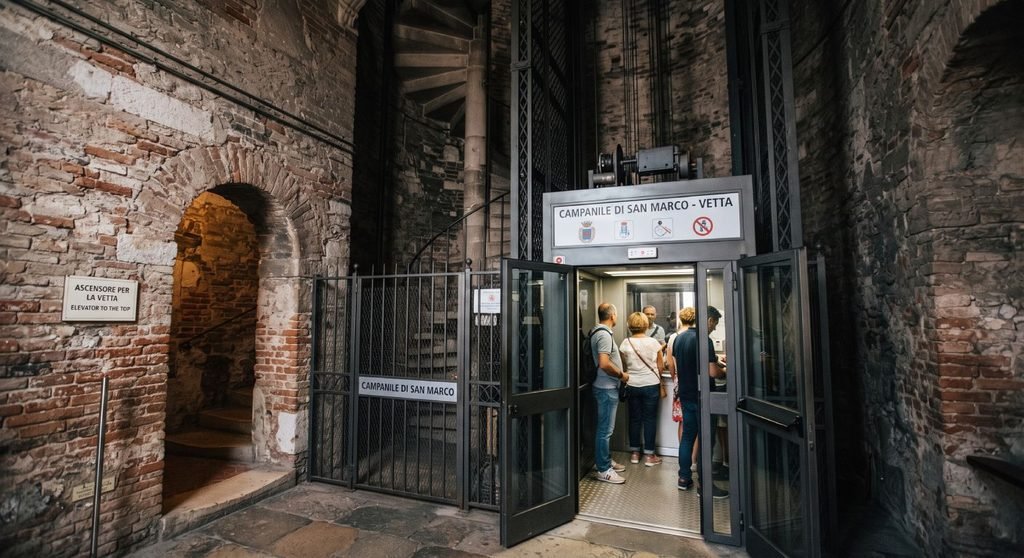
So How Does the Lift Actually Work?
An integrated vertical journey that transforms climbing a historic tower into an effortless ascent.
Seamless Integration
Built directly into the tower’s modern reconstruction, offering a smooth ride straight up the brick shaft.
Under a Minute
Takes well under a minute—leaving punishing tower staircases in other Italian cities far behind.
Genuinely Inclusive
Enables visitors with mobility needs or strollers to reach the top effortlessly without medieval stairs.
The elevator inside the Campanile isn’t a rickety add-on; it’s a fully integrated feature built during the tower’s reconstruction. You step in at ground level, the doors close, a brief hum sounds, and you emerge ninety-some metres above Piazza San Marco in under a minute. Compared to punishing staircases in Verona, Siena, or Rome, its effort-to-reward ratio sits at the very top of the leaderboard.
This makes the Campanile one of Italy’s most inclusive historic viewpoints. Travelers with mobility challenges, parents with strollers, or anyone exhausted by a hot summer afternoon can skip the medieval steps entirely. While peak-season queues happen, waiting on solid ground beats gasping for air on a tower staircase every single time.

What You Actually See Up There
Now, the part everyone’s actually here for: stepping out onto the belfry level for a 360-degree sweep of Venice.
South: Piazza San Marco
The full sweep of the square laid out like a scale model, with the Basilica domes, Doge’s Palace, and Procuratie wings.
East: The Lagoon & Lido
Views over the Bacino di San Marco, San Giorgio Maggiore, and the thin green line of the Lido separating the lagoon from the Adriatic.
North & West: Rooftops
Endless terracotta tiles, chimney pots, and the satisfying layout of the city’s sestieri, stretching out toward the Dolomites.
Stepping out of the lift puts you directly among the five historic bells, surrounded by covered walkways that frame a different slice of Venice on all four sides. Looking south, Piazza San Marco looks like a scale model; looking east, the lagoon opens toward San Giorgio Maggiore and the Lido; looking north and west, the city’s labyrinth finally makes satisfying sense from above.
For photographers, the covered arcade offers protection from direct sun. While sunset is spectacular, it is also the most crowded slot—meaning an early morning visit right after opening is the quiet secret to avoiding elbows in your panoramic shot.

Buying Tickets Without Headaches
Piazza San Marco is one of the most visited places in the world. With these essential tips, your visit to the bell tower will go extremely smoothly.
Book Ahead
Priority access tickets are ideal to prevent your patience from being severely tested in the warm Venetian sun.
Mind the Hours
Opening hours vary by season: longer hours in the summer and shorter windows or early closures in the winter.
Check the Weather
The viewing platform is open-air. By taking lagoon fog or cloudy days into account, you can enjoy a clear view.
St. Mark’s Square is one of the busiest public spaces in the world. Due to the immense popularity of the Campanile, long queues quickly form, especially between late morning and early evening during the high season (from April to October).
Plan smart and reserve on time: Skip-the-line tickets are indispensable if you don’t want to stand in the scorching sun for hours among tour groups. Always double-check seasonal opening hours and consider combining your visit with the adjacent St. Mark’s Basilica—alternating the golden mosaics on the ground with a breathtaking view from above makes for the ultimate Venice experience.
St. Mark’s Campanile: Entry Ticket
See sweeping views and hear about the city’s history with direct lift access to the top.
St. Mark’s Campanile: Entry Ticket
Experience Venice’s famous bell tower, ride the elevator up effortlessly, and enjoy breathtaking 360-degree views over the lagoon city.
A Brief Word on Bell Etiquette
Because you’ll be standing quite close to the five historic bells, it’s worth knowing how they behave when pealing today.
Still Ringing Today
The bells still ring on occasion to mark hours and civic or religious events, just as their predecessors did centuries ago.
Generous Acoustics
The acoustics up on the open-air belfry are, shall we say, generous—meaning you will definitely feel the sound waves.
A Memorable Clang
If your visit coincides with scheduled ringing, you’ll hear it in your ears for minutes afterward—memorable, if not always gentle!
Because you’ll be standing quite close to those five bells, it’s worth knowing that they do still ring on occasion, marking the hours and various civic and religious occasions, much as their predecessors did centuries ago.
Nobody expects modern Marangona (the largest bell, historically used to mark the start and end of the working day) to summon workers to the Arsenale anymore, but the acoustics up there are, shall we say, generous. If your visit happens to coincide with a scheduled ringing, you’ll know about it immediately and probably for several minutes afterward, in your ears. It’s a memorable part of the experience, if not always a gentle one.
Why the Elevator Matters More Than You’d Think
More than a minor logistical footnote, the lift genuinely changes who gets to experience one of Venice’s best views.
Inclusive for All Ages
Allows grandparents, toddlers, and anyone with joint pain or strollers to share the rooftop view without sitting out.
Saves Sightseeing Energy
Unlike Giotto’s Campanile in Florence, you bank your energy to explore Dorsoduro, Cannaregio, or Rialto.
Foresight of Planners
Early 20th-century civic planners had the vision to integrate an elevator rather than leaving the tower staircase-only.
It’s tempting to treat “there’s a lift” as a minor logistical footnote, but it genuinely changes who gets to experience one of Venice’s best views. Historic Italian towers are, almost as a rule, staircases with a view attached — beautiful, atmospheric, and entirely unforgiving toward anyone with joint pain, vertigo on tight spiral steps, a stroller, a wheelchair, or simply a healthy aversion to climbing 400 uneven medieval steps in July. The Campanile flips that script.
It’s also, frankly, just efficient. Where towers like Giotto’s Campanile in Florence require roughly 414 steps and a genuine cardiovascular commitment, Venice’s Campanile lets you bank all that energy for the rest of your sightseeing day — more steps left in reserve for wandering Dorsoduro, hunting down a decent spritz in Cannaregio, or getting mildly, happily lost near the Rialto Bridge.
Practical Tips for a Smooth Visit
A short, no-nonsense checklist for making the most of your ascent to St. Mark’s Campanile.
Timing Your Visit
Arrive early or late in the day for shorter queues, fewer crowds, and much softer light for photography.
Online Booking
Book tickets online ahead of your visit during high season to bypass unnecessary waiting in the plaza sun.
Practical Gear
Wear something practical for the breezy open-air gallery, and bring a wide-angle lens to capture the full sweep.
A short, no-nonsense checklist for making the most of your ascent:
- Arrive early or late in the day for shorter queues and softer light for photos.
- Check the weather forecast, since clear skies make an enormous difference to the view.
- Book tickets online ahead of your visit during peak season to avoid unnecessary waiting.
- Wear something practical, since the open-air gallery can be breezy even on a warm day — Venice’s lagoon winds don’t ask permission.
- Bring a wide-angle camera lens or phone, since the panoramic sweep is hard to capture in a single standard shot.
- Time it with the Basilica or Doge’s Palace to make the most of your time in the piazza.
- Don’t rush the descent view — the elevator ride down still offers a brief, satisfying glimpse of the tower’s interior brickwork, a small reminder that you’re inside a genuinely old structure, even one rebuilt from scratch.
A Tower With a Complicated Relationship With Standing Up
Before we get to the elevator, it helps to know a little about the tower it lives in, because the Campanile has had, let’s say, a dramatic life.
9th Century Origins
Construction began around the 9th century, originally serving as a dual-purpose lighthouse for the lagoon and a watchtower for the Doge’s Palace.
The 1902 Collapse
On 14 July 1902, the tower unexpectedly fell down after days of warnings, remarkably causing no human casualties except a disputed caretaker’s cat.
Rebuilt “As It Was”
The city council voted to rebuild it “dov’era e com’era” (where it was and how it was), completing the stronger, modern-foundation replica in 1912.
Construction on the bell tower began around the 9th century, originally serving a dual purpose as a lighthouse for boats navigating the lagoon and a watchtower for the Doge’s Palace next door. Over the following centuries it was rebuilt and reinforced multiple times, eventually taking the elegant, brick-and-stone form recognisable in every postcard of Piazza San Marco: a tall square shaft, a loggia partway up, a belfry with five bells (each historically assigned a different civic duty, from marking the start of the working day to announcing executions — Venetian bureaucracy at its most literal), a green pyramidal spire, and a golden statue of the Archangel Gabriel on top, doing his best weathervane impression.
And then, on 14 July 1902, the Campanile did something towers are generally not supposed to do: it fell down.
Witnesses reported hearing ominous cracking sounds for days beforehand, and city officials had enough warning to evacuate the piazza before the whole structure collapsed into a tidy pile of rubble. Remarkably, nobody was killed — the only casualty was the caretaker’s cat, according to popular legend, and even that story is disputed. The Venetian city council, in a display of civic determination that still deserves applause, voted the very next day to rebuild it “dov’era e com’era” — “where it was and how it was.” The reconstructed tower, completed in 1912, is a near-exact replica of the original, but engineered with stronger, more modern foundations.
Which brings us to today’s version of the Campanile: a tower that looks nine centuries old, is actually just over a hundred, and — crucially for your calves — was built in an era when elevators existed and someone thought, quite sensibly, “why not?”
The Bottom Line
Skip the suffering, embrace the payoff, and let the view do the work your legs won’t have to.
Democratic Infrastructure
A rare exception in Venice that opens up spectacular 360-degree views to anyone who can stand in a short queue.
Book the Ticket
Don’t file the Campanile under “climb later, if there’s time”—make it a priority in your Piazza San Marco itinerary.
A Small Miracle
In a city built on water, bridges, and endless steps, a smooth hundred-metre ride straight to the top is worth celebrating.
Venice rewards patience and a good pair of walking shoes almost everywhere else, but the Campanile di San Marco is the rare exception — an ancient, dramatic, rebuilt-from-rubble bell tower that lets you skip the suffering and go straight to the payoff. The lift isn’t just a convenience; it’s arguably one of the most democratic pieces of infrastructure in the entire city, opening up a genuinely spectacular 360-degree view of Venice, its lagoon, and the mountains beyond to essentially anyone who can stand in a queue for a few minutes.
So when you’re planning your day around Piazza San Marco, don’t file the Campanile under “climb later, if there’s time.” Book the ticket, ride the elevator, and let the view do the work your legs won’t have to. In a city built entirely on water, bridges, and an apparently endless supply of steps, that’s a small miracle worth celebrating — one smooth, hundred-metre ride at a time.
Is there an option to take the stairs instead of the elevator?
No. For safety, crowd control, and structural management, public access to the top is strictly via the elevator. There is no open staircase available for tourists to climb.
How long does the elevator ride take?
The ride to the top takes roughly 30 seconds. The elevator moves swiftly straight up the internal shaft of the brick tower.
How many people can fit in the elevator at once?
Capacity varies depending on safety regulations and staff management, but the elevator typically holds a limited group of people (usually around 6 to 10 passengers) per trip.
Are there long queues for the elevator?
Yes, especially during peak tourist hours (mid-day) and high seasons. Because capacity is limited by the elevator's size, wait times to board can sometimes stretch from 30 minutes to over an hour.
Can I skip the elevator line by booking in advance?
Yes. Buying a skip-the-line or timed-entry ticket online ahead of time allows you to bypass the main ticket purchase queue, though you will still join the boarding queue for the lift itself.
Is the elevator accessible for wheelchair users?
Yes. The elevator makes the observation deck accessible to wheelchair users and visitors with mobility impairments, provided the individual can navigate small spaces or minor thresholds at the top.
What happens if the elevator breaks down or there is a power outage?
The elevator is equipped with standard safety and backup systems. In the rare event of a technical malfunction or severe weather (such as high winds), the tower temporarily closes to new entries, and visitors are safely evacuated or brought down.
Are strollers or large bags allowed in the elevator?
Large bags, suitcases, and large strollers are generally not allowed inside the elevator or at the top due to space limitations. Visitors are encouraged to travel light, as there are no large luggage storage lockers directly at the tower base.
Can you see the view from inside the elevator during the ride?
No. The elevator travels inside an enclosed central brick shaft, so you will not see the view until the doors open directly into the open-air belfry at the top.