
Getting to the Venice Bell Tower by Foot: Routes, Times & Tips
No boat required. No confusion about which vaporetto line stops where. Just Venice, on foot, the way it was built to be experienced.
The Campanile di San Marco — St Mark’s bell tower — sits at the heart of Piazza San Marco, and every walking route in Venice eventually points toward it. This is the complete guide to getting there on your own two feet, from every major arrival point in the city.
Interactive Walking Routes Across Venice
Explore how your journey unfolds across Venice’s famous fish-shaped islands. Select a starting point below to see the precise walking path to the Campanile.
Exit Santa Lucia, follow “Per Rialto” through Cannaregio, cross the Grand Canal via the Rialto Bridge, and follow “Per San Marco” through the Mercerie straight to the tower.
Cross the modern Calatrava Bridge from Piazzale Roma into Santa Croce, join the signed path toward Rialto, and continue across the heart of the historic center.
Already exploring near the canal? Cross to the San Marco side and follow “Per San Marco” down the bustling Mercerie retail spine directly into the Piazza.
Getting to the Venice Bell Tower by Foot
Venice is entirely pedestrianized, making walking the most reliable method to reach St. Mark’s Campanile. Review the complete route data and metrics below:
| Starting Point / Focus | Distance & Time | Core Direction & Tactical Guidance |
|---|---|---|
| Santa Lucia Station | ~2 km (30–40 Mins) |
Follow “Per Rialto” through Cannaregio, cross the Rialto Bridge, then follow “Per San Marco” through the Mercerie straight to the Piazza. |
| Piazzale Roma | ~2.2 km (35–45 Mins) |
Cross the Calatrava Bridge into Santa Croce, join the signed route toward Rialto, switch to San Marco signage, and continue via the Mercerie. |
| Rialto Bridge | ~700 m (10–15 Mins) |
Cross to the San Marco side of the bridge and follow “Per San Marco” down the historic Mercerie retail spine directly into the Piazza. |
| Best Timing Window | Early Morning (< 9:30 AM) |
The single best window for quiet alleys, empty squares, and minimal queue wait times at the tower elevator. |
| Peak Crowd Control | Midday (11:00 AM–4:00 PM) |
Avoid if possible; cruise ship arrivals and tour groups create heavy pedestrian bottlenecks through the Mercerie. |
| Wayfinding Rule | Yellow Signs | Rely on painted building signs pointing toward Ferrovia, Piazzale Roma, Rialto, San Marco, and Accademia instead of phone GPS. |
Follow “Per Rialto” through Cannaregio, cross the Rialto Bridge, then follow “Per San Marco” through the Mercerie straight to the Piazza.
Cross the Calatrava Bridge into Santa Croce, join the signed route toward Rialto, switch to San Marco signage, and continue via the Mercerie.
Cross to the San Marco side of the bridge and follow “Per San Marco” down the historic Mercerie retail spine directly into the Piazza.
The single best window for quiet alleys, empty squares, and minimal queue wait times at the tower elevator.
Avoid if possible; cruise ship arrivals and tour groups create heavy pedestrian bottlenecks through the Mercerie.
Rely on painted building signs pointing toward Ferrovia, Piazzale Roma, Rialto, San Marco, and Accademia instead of phone GPS.
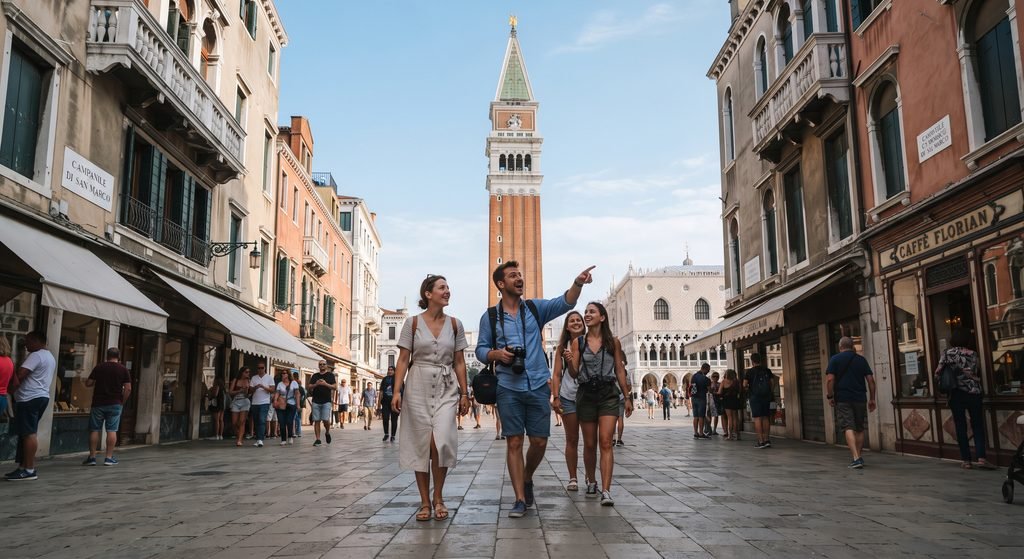
Why Walk in Venice?
Venice has no cars, no bikes, no scooters. Every street is a footpath. That single fact changes how the city works — and how you should approach getting around it.
Walking isn’t a fallback option. For the Campanile specifically, it’s usually the fastest choice available.
Between waiting for the boat and the stop-by-stop crawl along the Grand Canal, a determined pedestrian often arrives first.

Three Starting Points, Three Routes
Most visitors arrive in Venice from one of three places. Each has a direct, well-marked walking route to Piazza San Marco. None of them require a single boat ticket.
This is the route most first-time visitors will take, and it’s also the most scenic.
Exit the station and you’re immediately on the Grand Canal — the view alone is worth pausing for. From here, follow the yellow signs marked “Per Rialto” (to Rialto). Venice’s wayfinding system is one of the most reliable in Europe: at nearly every major intersection, a painted or posted sign points you toward the city’s key landmarks. San Marco is always one of them.
The route runs through Cannaregio, past the Chiesa di San Geremia, and into a dense stretch of shops, bacari (small wine bars), and residential calli. Stay with the “Rialto” signs until you reach the Rialto Bridge itself — one of four bridges crossing the Grand Canal, and the busiest.
Cross the bridge. On the far side, in San Polo/San Marco sestiere, the signage shifts to “Per San Marco.” Follow it through the Mercerie — a chain of narrow shopping streets that has connected Rialto to the Piazza for centuries — and you’ll walk directly into Piazza San Marco. The Campanile is the first thing you’ll see: it dominates the square from the moment you enter it.
If you’ve arrived by car, coach, or the People Mover from the cruise terminal, you’ll land at Piazzale Roma — the only point in Venice where wheeled traffic can enter.
From here, the fastest walking route crosses the Ponte della Costituzione (the modern glass-and-steel bridge, also called the Calatrava Bridge) into Santa Croce, then joins the same signed path toward Rialto described above. Follow “Per Rialto,” cross the bridge, switch to “Per San Marco,” and continue through the Mercerie to the Piazza.
An alternative path threads south through San Polo and past the Frari church before curving toward San Marco — slightly longer, noticeably quieter, and a good option if the main route feels too crowded.
Already near Rialto? This is the short version.
Cross to the San Marco side of the bridge and follow “Per San Marco” through the Mercerie di San Marco — the historic retail spine of the city, unchanged in function since the Republic era, even if the shopfronts have. The path is narrow, mostly pedestrianized by default (there’s no other kind of street here), and it funnels directly into the Piazza.
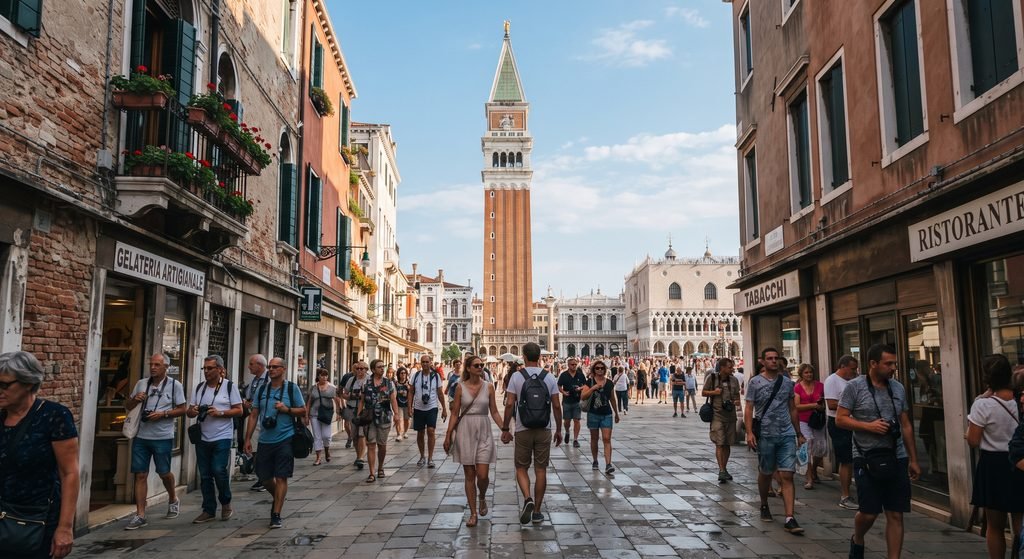
Reading Venice Like a Local
Venice’s layout defies conventional logic — it wasn’t planned on a grid, and no app will fully prepare you for it. But it isn’t chaos either. It runs on a system, and once you understand the system, you stop needing the map.
The Yellow Signs
Painted directly onto building corners or mounted on small posts, they point toward five key landmarks: Ferrovia, Piazzale Roma, Rialto, San Marco, and Accademia. Follow the names, not turn-by-turn directions.
Calli, Campi & Canals
A calle is a street; a campo is a square (San Marco is the only piazza). Because canals cut across both, your route will zigzag by necessity. Stay oriented by landmark, not compass direction.
Dead Ends Happen
Some calli terminate at a canal with no bridge. This is normal — Venice was built as a maze of private property lines from a thousand years ago. Just backtrack, rejoin the signed route, and keep moving.
Inconsistent Signal
Between tall buildings and narrow alleys, GPS can lag or drift. Download an offline map, but lean on the physical signage more than the blue dot — it’s more reliable here than almost anywhere else in Europe.
Arriving at the Piazza
This is the fifth tower on this site. The previous one collapsed without warning in 1902 — no injuries, remarkable given the crowds the Piazza has always drawn.
The current structure was rebuilt “dov’era e com’era” (where it was, and how it was), reopening in 1912. What looks ancient is, structurally, only a little over a century old.
To the Top in Under a Minute
Inside, an elevator carries visitors to the top in under a minute — a rare concession to modernity in a city with almost none. From the viewing platform, the view runs from the Adriatic to the Dolomites on a clear day, with the entire lagoon, its islands, and the terracotta rooftops of Venice laid out below.
Timing Your Walk and Your Visit
Early Morning
Before 9:30 AM is the single best window. The Mercerie are quiet, the Piazza is close to empty, and the tower’s queue — which can stretch well past an hour by midday in peak season — is minimal.
Midday
11:00 AM – 4:00 PM brings the crowds. Cruise ship arrivals, tour groups, and day-trippers converge on this exact route, and the Mercerie in particular can slow to a shuffle. If this is your only window, expect a longer walk and a longer line at the tower.
Late Afternoon & Early Evening
Offers a second good window, especially for the view — golden hour over the lagoon from the top of the Campanile is one of the best vantage points in the city, and foot traffic on the walking routes thins out noticeably after 5:00 PM.
Skip-the-Line Access
Exists for a reason: the Campanile’s elevator has real capacity limits, and timed-entry tickets prevent the kind of queue that can eat an hour of a short trip. Booking ahead is worth it in high season — it turns the tower from a queue-management problem into a five-minute stop.
Practical Notes for the Walk Itself
Footwear Matters
Footwear matters more than in most cities. Venice’s streets are stone and can be uneven or slick, especially near canals or after rain. Cobblestones and worn marble don’t forgive flip-flops.
Bridges Mean Stairs
Dozens of them, on every route into San Marco. If mobility is a concern, some routes (particularly via the Ponte della Costituzione) have step-free alternatives, but most historic bridges in the city center do not.
Acqua Alta Changes the Map
During high water season (typically autumn through early spring), parts of the route — especially low-lying stretches near Piazza San Marco itself — can flood. Raised walkways (passerelle) go up when this happens; check conditions if you’re visiting between October and March.
Pack Light
Narrow calli and bridge staircases are unkind to rolling luggage. If you’re walking from the station with bags, expect a slower pace and occasional awkward maneuvering across bridge steps.
Water Refills
Venice has public drinking-water fountains (nasoni) scattered throughout the city, including several along the main routes to San Marco. Bring a bottle; skip the bottled-water markup near the Piazza.
Walking vs. The Vaporetto
No horizontal scrolling required. Review how walking and the water bus stack up side-by-side on your phone screen:
Walking (City Center)
Completely Free
~30–40 Mins (via Rialto Bridge)
~35–45 Mins (via Calatrava Bridge)
Involves stepping up and down dozens of arched canal bridges.
Intimate views of historic alleys (calli), local shops, and neighborhood squares.
Foot traffic bottlenecks in the Mercerie during midday peaks (11 AM–4 PM).
Vaporetto (Water Bus)
€9.50 per single 75-min ticket (or 24h pass for €25)
20–25 Mins on Line 2 (Express) or 35–40 Mins on Line 1 (Local)
25–30 Mins on Line 2 or 40–45 Mins on Line 1
Seated on water; requires walking only 2–5 mins from the dock to the Piazza.
World-class open-air cruise experience straight down the Grand Canal.
Queues at docks during peak hours; boats can get crowded.
Which One Should You Choose?
The Pro Recommendation: If you want to save money and avoid dock queues, walking via the yellow wayfinding signs is exceptionally reliable. However, taking Vaporetto Line 1 or Line 2 at least once serves double-duty as a budget-friendly Grand Canal sightseeing tour. For full details on routes and docking schedules, check out the Campanile Vaporetto Transit Guide.
The Short Version
From the train station: follow “Per Rialto,” cross the bridge, follow “Per San Marco,” walk through the Mercerie.
From Piazzale Roma: cross the Calatrava Bridge, join the Rialto route, switch to San Marco signage.
From Rialto: follow “Per San Marco” through the Mercerie.
Go early or go late. Midday brings crowds to both the walking routes and the tower itself.
Trust the yellow signs over your phone’s GPS. They’ve been guiding people through this city for longer than GPS has existed.
How long does the walk take from the Venezia Santa Lucia train station?
Walking from the train station takes approximately 30 to 35 minutes at a steady pace. The route covers about 3 kilometers and requires crossing multiple bridges over canals.
How long does the walk take from the Rialto Bridge?
Walking from the Rialto Bridge to the Campanile takes about 10 to 12 minutes. It is a quick and scenic stroll through the heart of Venice's historic shopping and tourist districts.
How do I navigate the walking routes if I get lost?
Venice's maze of streets can be tricky for GPS. Look for the yellow rectangular signs posted high up on building corners. They feature black text pointing toward major landmarks like "Per San Marco" (To St. Mark's) or "Per Rialto".
Are the walking routes accessible for rolling luggage or strollers?
No, not easily. Walking anywhere in Venice means navigating arched stone bridges equipped with steps. Hauling heavy rolling suitcases or pushing a stroller entirely on foot can be exhausting and frustrating.
What is the best way to combine walking with public water transit (vaporetto)?
If you want to minimize long walks or are arriving from the train station/Piazzale Roma, a popular hybrid method is to take Vaporetto Line 1 or Line 2 down the Grand Canal, get off at the San Marco-Vallaresso or San Zaccaria stop, and walk just 3 to 5 minutes from the dock to the tower.
Is the walking path to the tower flat?
Aside from the arched steps on the canal bridges along your route, the walking paths themselves are generally flat paved stone (masegni). Once you arrive at Piazza San Marco, the entire square is completely flat and open.
Is it safe to walk to the Campanile late at night or early in the morning?
Yes. Venice is one of the safest cities in Europe for pedestrians at all hours. Early morning (before 8:00 AM) and late evening are exceptionally peaceful, atmospheric, and uncrowded for a walk to the square.
What should I wear on my feet for the walk?
Always wear sturdy, broken-in walking shoes with good traction. Venetian paving stones can be slick when wet, and you will be stepping up and down numerous bridge stairs. Avoid brand-new shoes or high heels.
What happens if there is high tide (acqua alta) during my walk?
If a high tide floods Piazza San Marco, the city installs elevated temporary wooden walkways (passerelle) so pedestrians can still cross the square dry-footed to reach the tower base.