
Visiting the Campanile di San Marco: The Bell Tower That Watches Over Venice
Few landmarks capture the spirit of Venice quite like the Campanile di San Marco. Rising nearly 99 meters above St Mark’s Square, this freestanding bell tower has served as a lighthouse, a watchtower, a place of execution, and — for over a thousand years — the city’s most recognizable silhouette. Climb to the top and you’re rewarded with what many visitors call the single best view in Venice: a sweeping panorama over red-tiled rooftops, the lagoon, and the distant Dolomites on a clear day.
If you’re planning a trip to Venice, the Campanile deserves a firm spot on your itinerary. This guide covers everything you need to know before you go — history, tickets, what to expect on the climb, the best time to visit, and answers to the questions most travelers have.
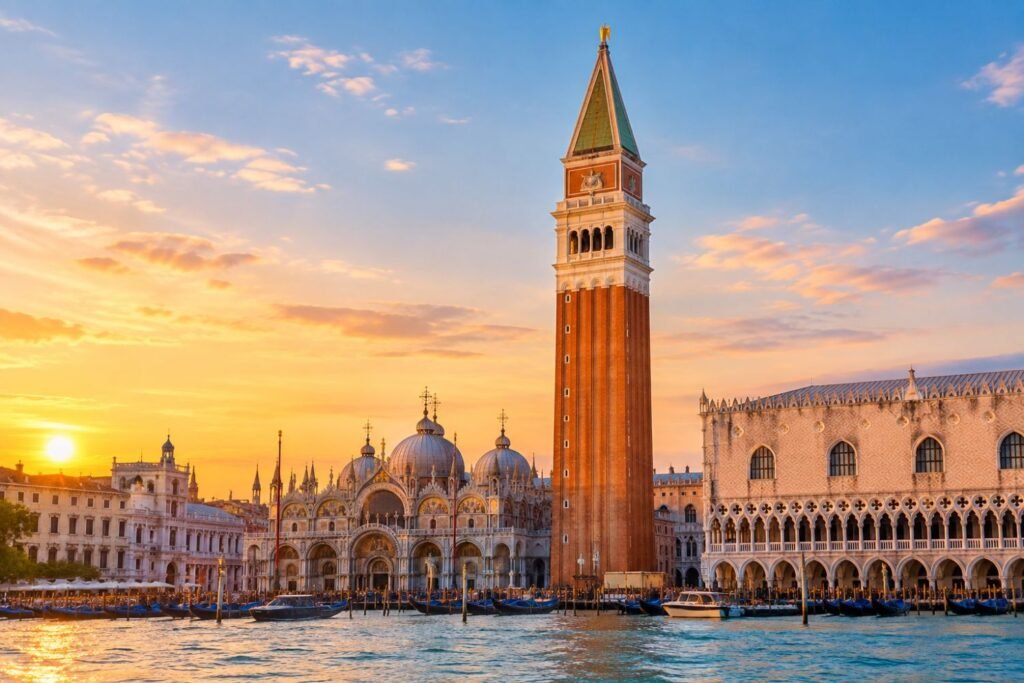
St. Mark’s Campanile Ticket
Skip-the-line ticket for St. Mark’s Campanile in Venice including an audio guide. Enjoy panoramic views over the city online.
10 Most Interesting Facts About St. Mark’s Campanile
Discover the fascinating history, architecture, and hidden legacy of Venice’s tallest and most iconic bell tower.
| # | Fascinating Fact | Historical Detail & Significance |
|---|---|---|
| 0101 | Ancient Roots | The bell tower has stood in some form or another in Piazza San Marco since the ninth century. |
| 0202 | Sudden Collapse in 1902 | The original historic tower collapsed unexpectedly on July 14, 1902, remarkably without causing any human casualties. |
| 0303 | Rebuilt “As It Was” | It was meticulously reconstructed over the following decade using the exact same brick-and-stone footprint and design. |
| 0404 | Towering Height | Standing at just under 99 meters (323 feet), it remains the tallest single structure across the entirety of Venice. |
| 0505 | Original Navigation Landmark | Centuries ago, the tower originally functioned partly as a lighthouse and navigation marker to guide sailors safely through the lagoon. |
| 0606 | The Golden Angel Vane | The summit is crowned by a striking golden statue of the archangel Gabriel that acts as a weather vane atop the spire. |
| 0707 | Effortless Modern Ascent | Unlike most ancient Italian bell towers, it features a modern elevator system, sparing visitors from climbing hundreds of stairs. |
| 0808 | Clear Weather Mountain Views | On exceptionally clear days, the open-air belfry provides visibility stretching all the way to the snow-capped peaks of the Dolomites. |
| 0909 | Historic Scientific Site | Galileo Galilei famously used the Campanile in 1609 to demonstrate his newly invented telescope to the Venetian Doge. |
| 1010 | Five Historic Bells | The belfry houses five historic bells, each historically assigned to a specific civic or religious duty in the Republic of Venice. |
A Quick Overview
The Campanile di San Marco stands in the northwest corner of Piazza San Marco, separate from the Basilica itself, featuring a tall brick shaft, simple design, and an elevator ride to a 360-degree open-air viewing gallery.
Location & Structure
Stands in the northwest corner of Piazza San Marco, separate from the Basilica, reaching just under 99 meters tall as one of the tallest brick buildings in Europe.
Deliberately Simple Design
Unlike surrounding Gothic and Byzantine facades, it features a tall brick shaft, belfry, pyramidal spire, and a golden weathervane angel.
The Visitor Experience
Ride an elevator straight to the top with no exhausting stair climb required, stepping out onto a 360-degree open-air viewing gallery.
A Brief History of the Tower
From its origins as a 9th-century watchtower to Galileo’s telescope demonstration, its historic civic bells, and the dramatic 1902 collapse and rebuild.
Origins & Historic Bells
Started as a 9th-century watchtower, later housing five distinct bells with unique civic functions, from the working-day Marangona to the notorious bell of the condemned.
Galileo’s Demonstration
In 1609, Galileo Galilei demonstrated his telescope from the top of the Campanile to the Doge and Venetian Senate, showcasing its military value.
The 1902 Collapse & Rebuild
The tower collapsed into rubble on July 14, 1902, with zero human casualties, and was meticulously rebuilt “com’era, dov’era” by 1912.
What You’ll See at the Top
The reason most visitors climb the Campanile isn’t for the bells or the history — it’s for the view, and it does not disappoint from the open-air gallery.
Piazza San Marco & Lagoon
An uninterrupted look down onto Piazza San Marco with the Basilica’s domes, Doge’s Palace, San Giorgio Maggiore, and busy boat traffic across the water.
Distant Horizons & Rooftops
On clear days, spot the Dolomites to the north, the islands of Murano and Burano, and a dense patchwork of terracotta tiles, chimneys, and narrow canals below.
The Full 360-Degree Loop
Walk the entire gallery loop to see the city from every angle: toward the Rialto Bridge, the Arsenale, the Giudecca Canal, and back toward the mainland.
Planning Your Visit
Essential tips covering advance tickets, seasonal opening hours, ideal visiting times, and accessibility features to ensure a smooth trip.
Tickets & Passes
Book online via platforms like Tiqets, GetYourGuide, and Viator to skip long lines. Consider combined tickets bundling the Doge’s Palace or Correr Museum.
Opening Hours & Timing
Hours shift seasonally from around 9:00/9:30 am to 5:30 pm in low season or 9:00 pm in summer. Aim for early morning or sunset for softer light and fewer crowds.
Accessibility & Weather
Features an elevator instead of stairs, making it realistic for visitors with mobility limitations. Clear days offer visibility all the way to the Dolomites.
How Long Should You Spend There
Most visitors spend somewhere between 30 and 45 minutes at the Campanile, covering the elevator wait, time at the top, and the return trip down.
Standard Visit Duration
Expect to budget 30 to 45 minutes total, which includes the elevator wait, experiencing the viewing platform, and the elevator ride back down.
Busy Periods & Queuing
If you arrive during a busy period, factor in extra time for queuing—even with a pre-booked ticket—since the elevator has limited capacity and moves visitors in batches.
Time for Photographers
Photographers or anyone hoping to do a full slow circuit of the gallery in good light should budget closer to an hour.
Practical Tips for Your Visit
Essential advice for your trip, covering advance bookings, dress codes for breezy heights, combining sights, and seasonal flood forecasts.
Book Ahead & Dress for Wind
Summer afternoons can bring hour-long queues without pre-booked tickets. Bring a light jacket since the open-air gallery 99 meters up is noticeably breezier.
Combine Sights & Watch Bells
Pair your visit with the nearby Basilica and Doge’s Palace. If you visit on the hour, you’ll hear and feel the historic bells ring from just below the gallery.
Photos & Flood Forecasts
Bring a wide-angle lens or phone panorama mode for the expansive views. Check flood forecasts in autumn/winter for seasonal acqua alta in Piazza San Marco.
Nearby Sights Worth Combining With Your Visit
Because the Campanile sits at the heart of Piazza San Marco, it’s easy to build an entire morning or afternoon around it without much walking at all.
St Mark’s Basilica & Doge’s Palace
Pair the Campanile’s big-picture view with the Basilica’s gold mosaics and the historical museum and Bridge of Sighs at the adjacent Doge’s Palace.
Correr Museum & Clock Tower
Explore the quieter Correr Museum framing the square, or take a guided tour through the mechanism of the historic Torre dell’Orologio.
San Giorgio Maggiore
Take a short vaporetto ride out to San Giorgio Maggiore for a mirror-image view back toward Piazza San Marco with far fewer crowds.
How the Campanile Compares to Venice’s Other Towers and Viewpoints
Venice has no shortage of places to see the city from above, and it’s worth knowing how the Campanile stacks up against alternatives so you can decide how to spend your time.
San Giorgio Maggiore
Often cited as an “insider’s” alternative, it offers the reverse view looking back at the Piazza San Marco skyline with the trade-off of vaporetto travel time and cost.
Scala Contarini del Bovolo
A striking spiral staircase tower near Campo Manin that provides an intimate rooftop view over the surrounding neighborhood rather than a sweeping panorama.
The Ultimate Choice
The Campanile di San Marco remains the most central, historically significant, and accessible viewpoint, making it the top recommendation if you only have time for one.
A Note on Sustainable Visiting
Venice has faced well-documented pressure from mass tourism, making thoughtful visits vital to spread the impact and enjoy a better experience.
Book Ahead & Time Slots
Booking ahead rather than adding to unpredictable queues and choosing early morning or late afternoon slots helps manage crowd pressure around Piazza San Marco.
Explore Quieter Streets
Taking a little time to explore the quieter streets beyond the square once you’ve come back down spreads the impact of your visit.
Slow Down at the Top
Venice rewards travelers who slow down—take the extra few minutes to walk the full loop of the gallery rather than heading straight back down.
Final Thoughts
The Campanile di San Marco is one of those rare attractions that lives up to its reputation, offering a genuinely unforgettable view that becomes a defining memory of your trip to Venice.
Unforgettable Views
Not a hidden gem, but one of the most visited sights in Venice for a simple reason: the view from the top is genuinely unforgettable.
Defining Memories
Whether watching the sun rise, tracing the Grand Canal, or taking in a city built on water, the minutes spent at the top will define your trip.
Plan & Enjoy
Book your ticket in advance, pick your time of day with light and crowds in mind, and give yourself unhurried minutes at the railing.
St. Mark’s Campanile: Entry Ticket
See sweeping views and hear about the city’s history with direct lift access to the top.
St. Mark’s Campanile: Entry Ticket
Experience Venice’s famous bell tower, ride the elevator up effortlessly, and enjoy breathtaking 360-degree views over the lagoon city.
Can I go up to the top of the bell tower?
Yes. Visitors can take an elevator all the way to the belfry (the bell chamber) for a 360-degree view of the city, the Venetian Lagoon, and on clear days, the distant Alps.
Do I have to climb stairs to reach the top?
No. Unlike many historic towers in Europe, the Campanile features a modern elevator that whisks visitors quickly to the top platform, making it accessible to most people.
How much do tickets cost?
Standard adult tickets generally cost around 12 to 15 euros. Discounted tickets are usually available for students, children, or specific groups. It is always best to check the official ticket office for the most up-to-date pricing.
Can I buy tickets in advance?
Yes. You can purchase skip-the-line or timed-entry tickets online beforehand. This is strongly recommended, especially during peak tourist seasons (spring and autumn), to avoid long wait times.
What are the opening hours?
Opening hours vary by season:
Low Season (November to April): Typically from 9:30 AM to 5:30 PM.
High Season (May to October): Often extended from 8:30 AM to 9:00 PM or later.
Note: Hours can change due to weather or maintenance.
Is the bell tower accessible for people with disabilities?
Partially. Because there is an elevator to the top, wheelchair users and visitors with mobility impairments can reach the observation deck. However, there may be a few small steps or tight spaces to navigate depending on crowd levels.
Are there still working bells in the tower?
Yes. The tower houses five historic bells, each with a unique historical function in the Venetian Republic (such as signaling the start of the workday, the noon hour, or meetings of the Great Council). They still ring regularly today.
What happened to the original tower?
The original tower, begun in the 12th century, completely collapsed on July 14, 1902, miraculously without causing any casualties (except for a caretaker's cat). It was painstakingly rebuilt “dov’è, com’è” (where it was, how it was) and reopened in 1912.
When is the best time of day to visit?
The best time is early morning right when it opens or late afternoon just before sunset. Late afternoon provides gorgeous golden-hour lighting over the Venetian rooftops and canals for photography.