
How to Get to the Campanile di San Marco in Venice by Vaporetto
Venice does not have taxis in the way most cities do, and it certainly has no metro tunneling under its canals. What it has instead is the vaporetto — the public water bus that has been ferrying Venetians and visitors around the lagoon for more than a century. If you are planning a trip to St Mark’s Campanile, the soaring bell tower that anchors Piazza San Marco and offers the best panoramic view in the city, arriving by vaporetto is not just possible, it is genuinely one of the most enjoyable ways to approach it. You get the added bonus of watching the Campanile rise over the water long before you set foot on dry land.
This guide walks through exactly which lines to take, which stop to get off at, how long it takes from Venice’s main arrival points, what a ticket costs, and a handful of practical tips that will save you time and confusion once you’re standing on a crowded pontoon trying to read a departure board for the first time.
Key Landmarks & Views from St. Mark’s Campanile
Click any major viewpoint or surrounding monument below to pin its location on Google Maps and see what you can spot from the top of the tower.
Navigating Lines 1 & 2 to St. Mark’s Campanile
Compare Venice’s two core water bus lines side-by-side using official transit mapping to choose between a leisurely Grand Canal sightseeing voyage or a rapid express connection.
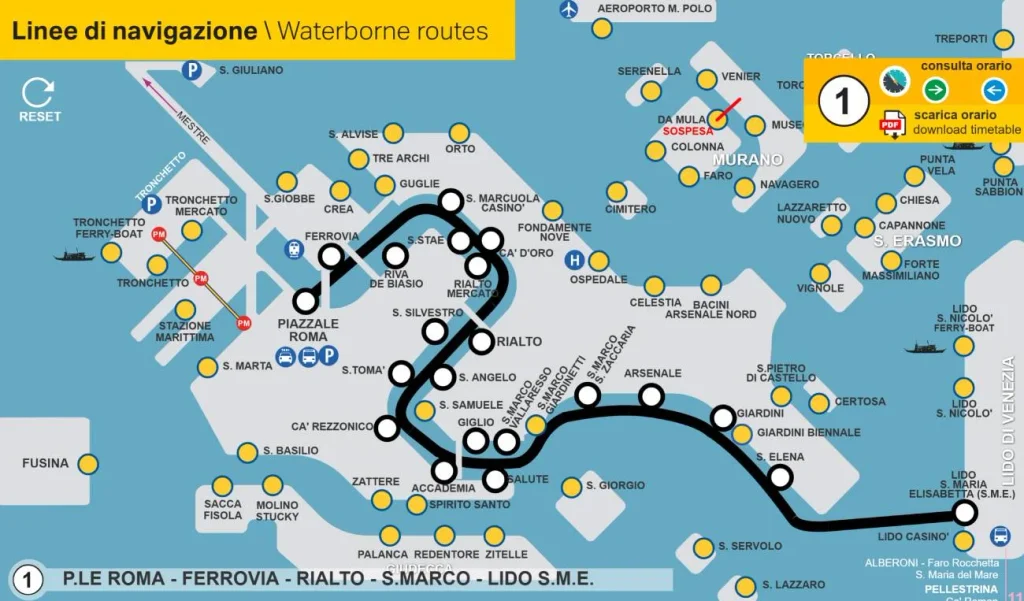
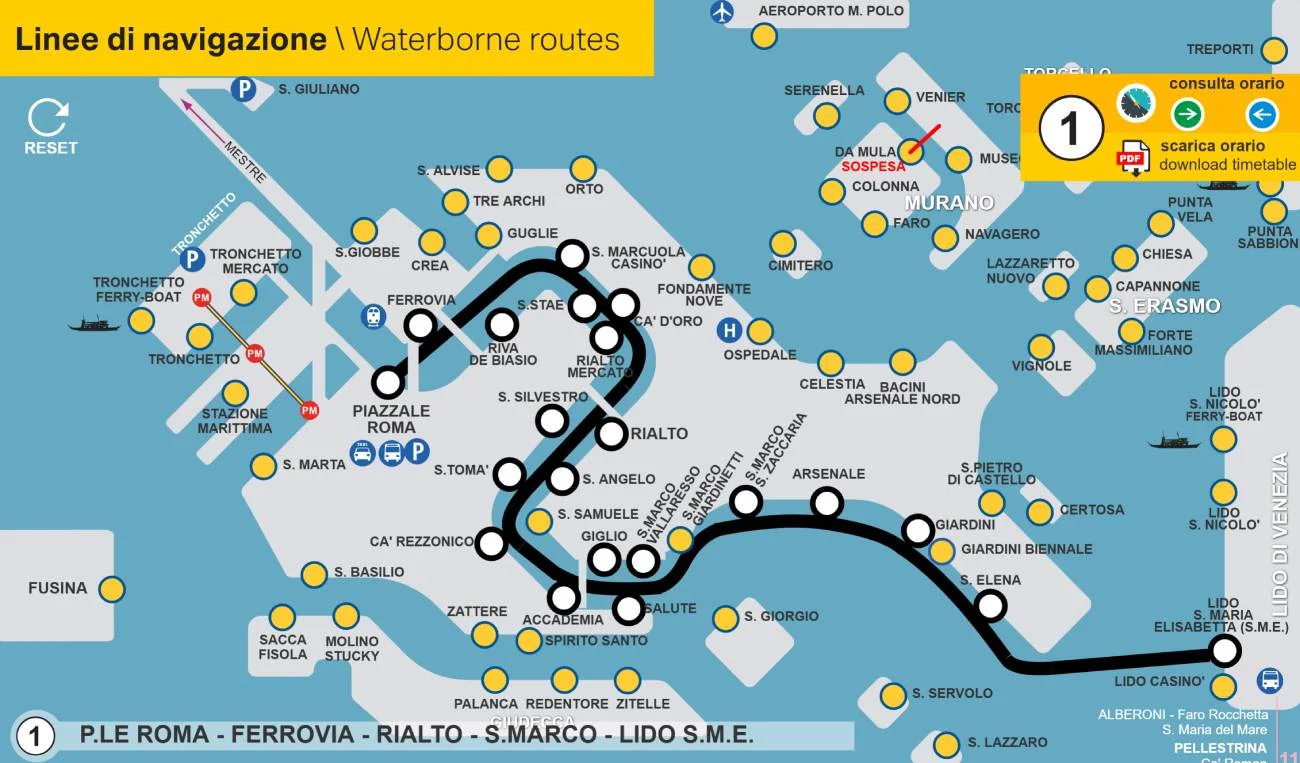
The Grand Canal Scenic Route
Line 1 crawls down the entire serpentine length of the Grand Canal, stopping at virtually every pier. It serves as a floating tour past historic palazzi and the Rialto Bridge before reaching San Marco.
- Pacing: Slow, multi-stop local route
- Best For: First-time sightseers & photography
- Path: P.le Roma ➔ Ferrovia ➔ Rialto ➔ San Marco
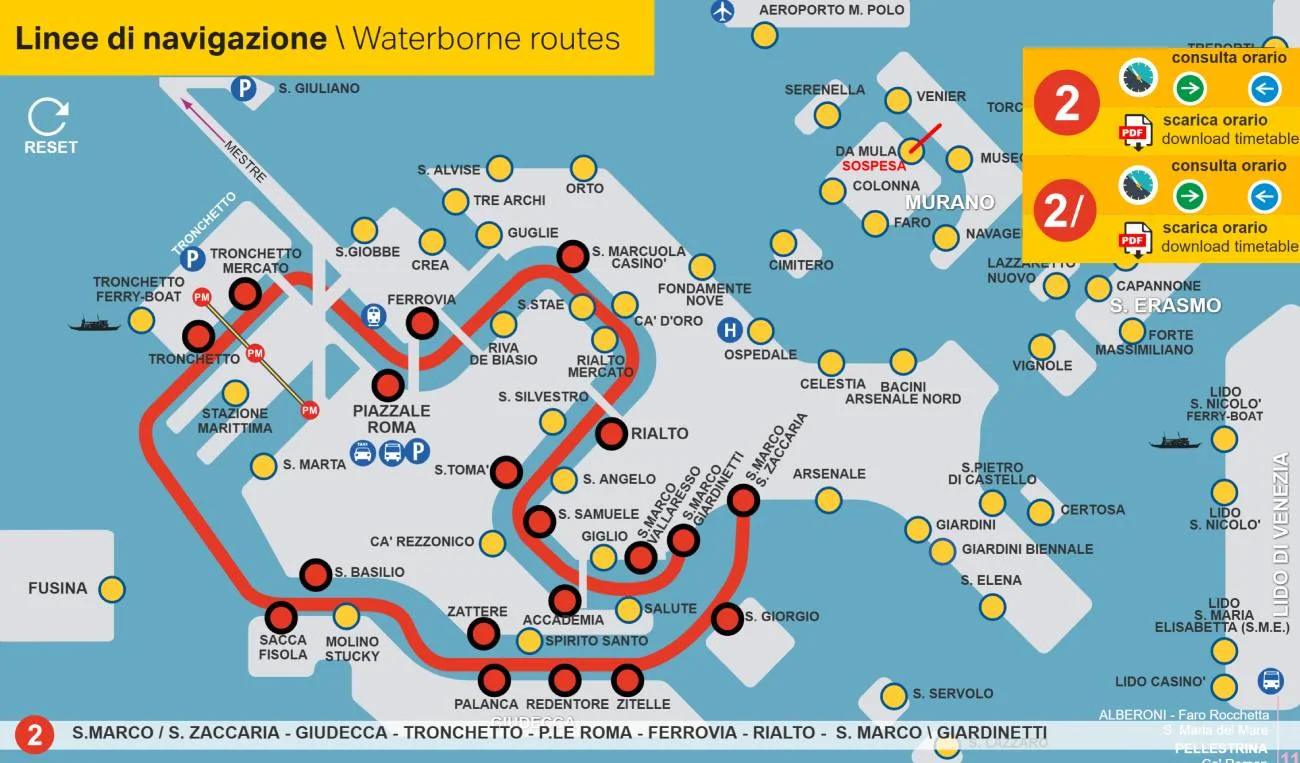
The Faster Express Option
Line 2 operates more like an express service, bypassing numerous intermediate piers. During daytime hours, its Grand Canal variant slices transit time down significantly, making it ideal when you want to reach the tower quickly.
- Pacing: Semi-express, skips piers
- Best For: Speed, luggage transit & efficiency
- Path: Grand Canal / Giudecca loop variants
Visualizing the Corridors
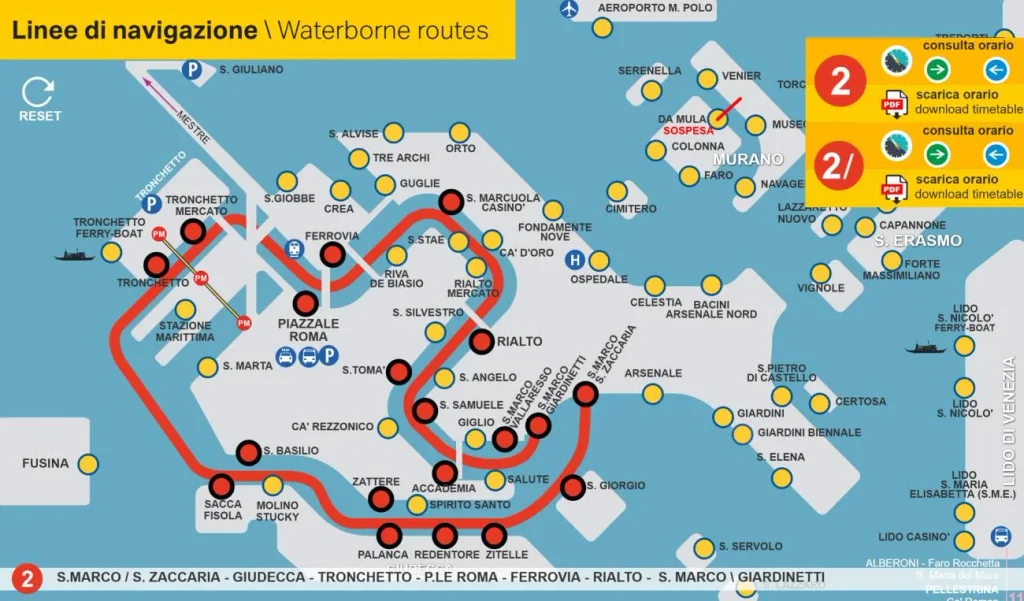
Official ACTV network mapping highlighting the contrast between Line 1’s full Grand Canal thread and Line 2’s hybrid express loop. Click any map to enlarge.
Venice Vaporetto Pass Breakdown & Comparison
Standard single-ride waterbus fares run €12.50 per journey, making transit costs add up quickly. Selecting the ideal pass for your itinerary is the smartest way to keep your Venice holiday budget under control. Review the duration limits, cost thresholds, and target travelers below:
| Pass Category | Active Window | Value Threshold | Ideal For |
|---|---|---|---|
|
75-Min Single
|
75 Minutes | 1 Journey | Station-to-accommodation arrival |
|
24-Hour Pass
|
24 Hours | 3 Journeys | Whistle-stop day trips & highlights |
|
48-Hour Pass
|
48 Hours | 4 Journeys | Weekend escapes & lagoon excursions |
|
72-Hour Pass
Top Pick
|
72 Hours | 5 Journeys | Standard 3 to 4 day getaways |
Which Traveler Profile Matches You?
Single 75-Min Ticket
Ideal for: Visitors committed to walking everywhere who only need a single water transit trip to haul heavy suitcases from Santa Lucia station or Piazzale Roma directly to their lodging.
24-Hour Pass
Ideal for: Fast-paced day visitors aiming to pack maximum sightseeing into a single day—gliding down the Grand Canal, touring St. Mark’s area, and catching a scenic sunset cruise.
48-Hour Pass (2-Day)
Ideal for: Short weekend stopovers spanning two full days. Perfect for discovering central Venice on Day 1 and making a seamless jump out to the colorful islands of Murano and Burano on Day 2.
72-Hour Pass (3-Day)
Ideal for: Traditional 3 to 4-day holidays. By validating your pass on the afternoon of your arrival day, you can expertly stretch its coverage across 4 distinct calendar days!
The Smart Savings Formula: If you anticipate boarding more than 1 or 2 boats daily, transitioning to a multi-day pass pays for itself instantly while shielding you from long queues at ticket kiosks every time you hop on.
How to Get to the Campanile in Venice by Vaporetto
10 essential points for navigating Venice’s public water bus system directly to the foot of St. Mark’s Campanile.
| # | Vaporetto Key Point | Description & Practical Details |
|---|---|---|
| 01 | The Vaporetto Advantage | Venice’s car-free historic center makes the water bus faster, cheaper than water taxis, and less tiring than walking with luggage. |
| 02 | San Marco Stops | San Marco Vallaresso and San Marco Giardinetti are the main Grand Canal pontoons, sitting just a 2 to 3 minute walk from the tower. |
| 03 | San Zaccaria Alternative | Located 5 to 7 minutes east along the Riva degli Schiavoni waterfront, offering a less congested disembarkation option during peak season. |
| 04 | Line 1 (The Scenic Route) | Travels the full length of the Grand Canal, taking 35 to 45 minutes from Piazzale Roma while stopping at nearly every pier. |
| 05 | Line 2 (The Faster Option) | Acts more like an express route skipping intermediate stops, getting you from the train station to San Marco in about 25 minutes during daytime hours. |
| 06 | From Piazzale Roma | For those arriving by car or bus, both Line 1 and Line 2 depart directly from the docks outside the terminal. |
| 07 | From Santa Lucia Station | Exiting the train station brings you straight to water pontoons (lettered A through F) with identical line and timing options. |
| 08 | From Marco Polo Airport | Requires an airport bus to Piazzale Roma or the direct Alilaguna boat service that enters the San Marco basin. |
| 09 | Ticket Validation Rule | Physical paper tickets must be stamped at the yellow machines on the pontoon before boarding to prevent on-the-spot fines. |
| 10 | Real-Time Display Checks | Always rely on electronic signs above the pontoon rather than static maps or apps, as routes and schedules shift seasonally. |
A Quick Word on the Campanile Itself
St. Mark’s Campanile has stood in one form or another since the ninth century, though the tower visitors see today is largely a careful reconstruction.
Reconstruction & Height
The original collapsed suddenly in 1902 and was rebuilt over the following decade using the same brick-and-stone design, standing at just under 99 meters tall.
Effortless Elevator Access
Unlike most of the city’s bell towers, it features an elevator, so the climb to the top costs no effort beyond a short wait in line.
Spectacular Belfry Views
The view from the belfry takes in the whole lagoon, the historic center rooftops, and on a clear day, the outline of the Dolomites far to the north.
Why the Vaporetto Is the Right Choice
Venice’s historic center is closed to cars, scooters, and bicycles, meaning everything moves either on foot or on water.
Faster & Less Tiring
For visitors staying near the Grand Canal, the Lido, or outer edges, the vaporetto is faster and far less tiring than walking with luggage.
Cost-Effective Travel
It is considerably cheaper than a water taxi, which can run into the hundreds of euros for a short hop across the lagoon.
The Grand Approach
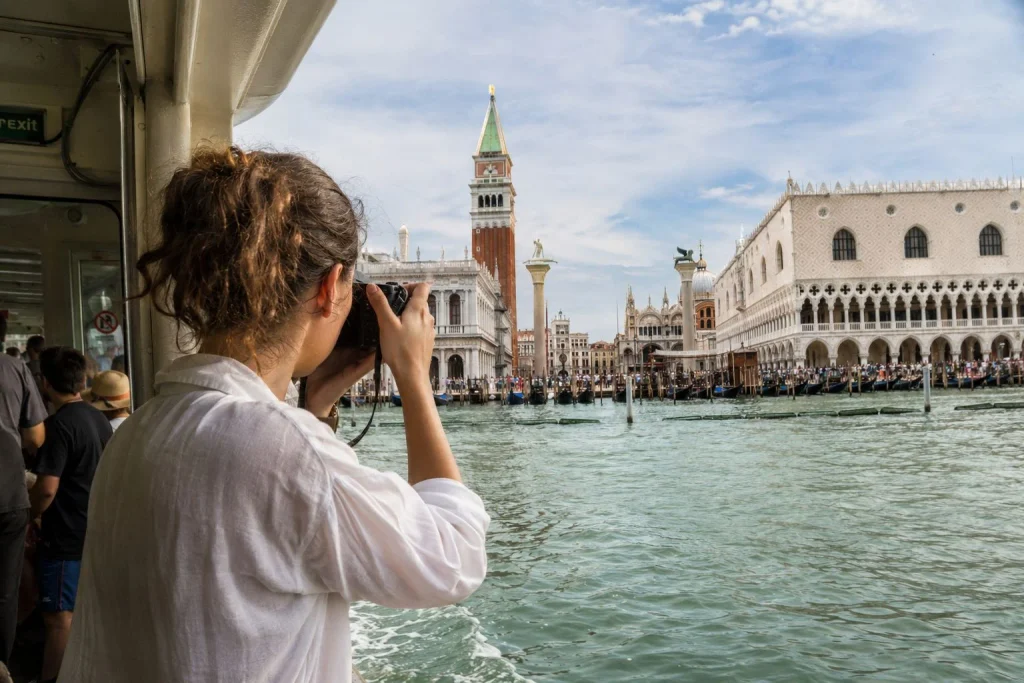
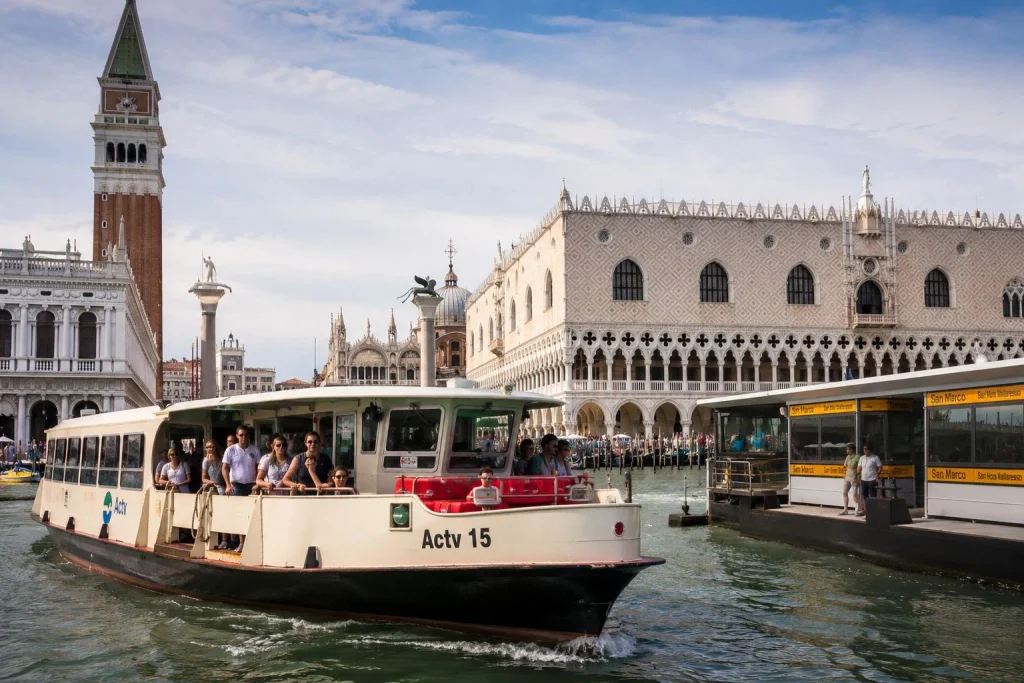
Approaching San Marco by water reveals the Doge’s Palace, Basilica domes, and Campanile shaft in a view unchanged for five hundred years.
Which Vaporetto Stop Do You Need?
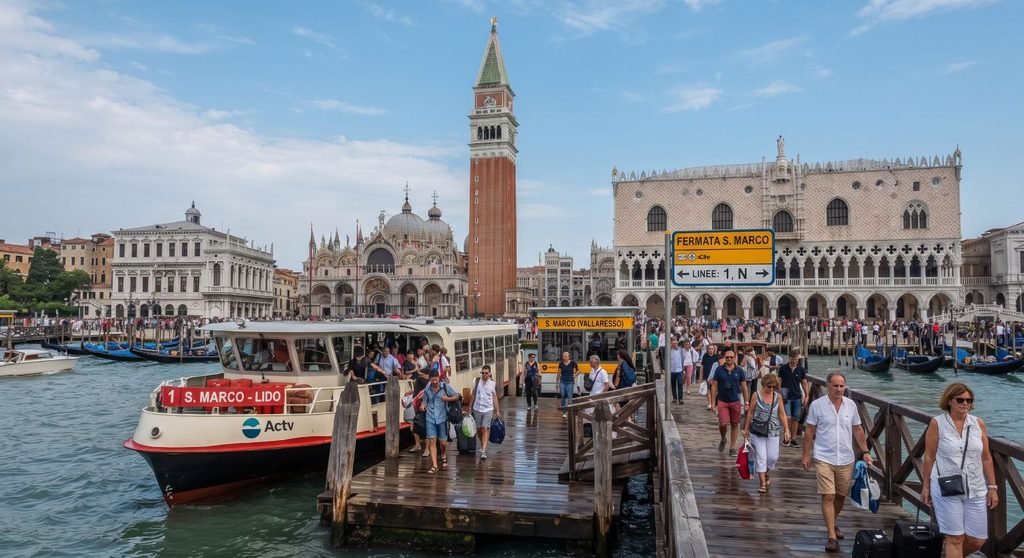
The Campanile sits in Piazza San Marco, and the vaporetto stops that serve this part of the city carry the name “San Marco” or “San Zaccaria”, depending on the exact pontoon.
San Marco Vallaresso & Giardinetti
These are the two San Marco stops on the Grand Canal side, just a two to three minute walk from Piazza San Marco and the Campanile.
San Zaccaria Stop
Located a short walk further east along the waterfront (Riva degli Schiavoni), roughly five to seven minutes from the square.
A Relaxed Alternative
San Zaccaria tends to be a little less congested than San Marco itself, especially during peak season, making it a more relaxed disembarkation point.
Which Lines to Take
Not every vaporetto line passes through San Marco, so it helps to know exactly which numbers and letters to look for on the electronic display before you board.
Line 1 — The Scenic Route
Travels the full length of the Grand Canal, stopping at nearly every pier. It takes 35 to 45 minutes from Piazzale Roma, offering views of the palazzi and the Rialto Bridge.
Line 2 — The Faster Option
Behaves more like an express route, skipping intermediate stops. During daytime hours, a Grand Canal variant gets you from the train station to San Marco in about 25 minutes.
Line N & Lines to Avoid
Line N covers midnight to 5:00 AM for a quiet night ride. Skip outer-ring lines like 4.1, 4.2, 5.1, 5.2, 6, and island-bound lines 9+ as they don’t serve San Marco directly.
Getting There From Venice’s Key Arrival Points
Find the best vaporetto routes and transit options depending on whether you are arriving from Piazzale Roma, the train station, the airport, or the Lido.
Piazzale Roma & Train Station
From Piazzale Roma, Line 1 takes 35–45 minutes and Line 2 takes 25–30 minutes. From Santa Lucia Station, both lines stop nearby with similar journey times.
From the Airport
Marco Polo Airport requires taking an airport bus to Piazzale Roma or the Alilaguna boat service directly into the San Marco basin.
From the Lido
If staying on the Lido, Line 1 runs directly back toward San Marco and continues to Piazzale Roma as a straightforward one-line journey.
What a Ticket Costs and How to Buy One
Venice’s vaporetto system runs on time-based tickets rather than distance-based fares, which works in your favor if you’re only making a short hop to San Marco.
Single Tickets
Valid for 75 minutes of travel and priced at around €9.50, comfortably covering a one-way trip from Piazzale Roma or Ferrovia to San Marco.
Multi-Day Passes
Offers 24-hour, 48-hour, or 72-hour unlimited travel via Venezia Unica, working out cheaper for multiple daily hops or trips to Murano and Burano.
Purchase & Validation
Tickets are available at automated kiosks, ACTV booths, or online. Always validate paper tickets at pontoon yellow machines to avoid fines.
Practical Tips for a Smooth Trip
Ensure a seamless journey by checking electronic displays, watching directions, managing multi-pontoon stops, and booking your Campanile ticket ahead of time.
Displays & Directions
Check the electronic display rather than printed maps, and always watch the direction indicator since lines like Line 2 can run in different loops.
Pontoons & Timing
Big stops feature multiple pontoons, and arriving early helps you secure a spot with a view on deck while avoiding the late-morning rush.
Advance Ticket Booking
Book your Campanile ticket in advance to walk straight from the vaporetto stop to the fast-track line instead of waiting in the general queue.
Putting It All Together
Reaching the Campanile by vaporetto comes down to two choices: pick Line 1 for a classic Grand Canal tour or Line 2 to skip ahead.
Line Selection
Pick Line 1 for a slow-motion tour of the Grand Canal, or choose Line 2 to save sightseeing for when you are back on solid ground.
Arrival Stops
Get off at San Marco Vallaresso, San Marco Giardinetti, or San Zaccaria to find yourself at the foot of the bell tower within a few minutes’ walk.
The Historic Approach
Approaching by vaporetto lets you watch the tower grow taller against the sky, experiencing Venice the way it was meant to be seen.
How do I get to the Campanile from the Santa Lucia Train Station by vaporetto?
Head to the docks outside the station and take Vaporetto Line 1 (scenic, all stops along the Grand Canal) or Line 2 (faster, semi-direct). Get off at either San Marco–Vallaresso or San Zaccaria.
How do I get to the Campanile from Piazzale Roma (the bus/car terminal)?
Just like from the train station, board Line 1 or Line 2 from the docks at Piazzale Roma. Ride it down the Grand Canal and disembark at the San Marco–Vallaresso or San Zaccaria stop.
Which vaporetto line gives the best sightseeing views on the way to the bell tower?
Line 1 is recommended if you want to sightsee. It travels the entire length of the Grand Canal, weaving under the Rialto Bridge and past historic palazzos before arriving near St. Mark’s Square.
Which vaporetto line is the fastest from the main transit hubs?
Line 2 is faster because it skips many of the smaller local stops that Line 1 makes, cutting down your transit time across the city.
How do I get to the Campanile if I am coming from Venice Marco Polo Airport?
You can take the Alilaguna Blue Line water shuttle directly from the airport dock, which stops right at San Zaccaria or San Marco. Alternatively, take an airport land bus to Piazzale Roma, then switch to vaporetto Line 1 or 2.
How long is the walk from the vaporetto stop to the actual bell tower door?
Once you step off the boat at San Marco–Vallaresso or San Zaccaria, it takes about 3 to 5 minutes on foot. You simply follow the street signs toward San Marco, and you will walk right into the square where the tower stands.
How much does a vaporetto ticket cost, and where do I buy it?
A standard single-ride ticket costs around €10 and is valid for 75 minutes. If you plan to ride multiple times, a 24-, 48-, or 72-hour tourist pass is much cheaper. You can buy them at ACTV ticket booths, tobacco shops (tabacchi), or via the official AVM Venezia app.
Do I need to validate my vaporetto ticket before getting on the boat?
Yes. You must tap your ticket or travel card against the electronic turnstile sensors at the floating dock before entering the boarding area. Failing to do so can result in a heavy fine.
Can I take a vaporetto to the Campanile late at night?
Yes, but regular daytime lines (like Lines 1 and 2) reduce their frequency or change routes late at night. Night service lines (such as the N line) run through the Grand Canal during the overnight hours to connect you to the San Marco area.